
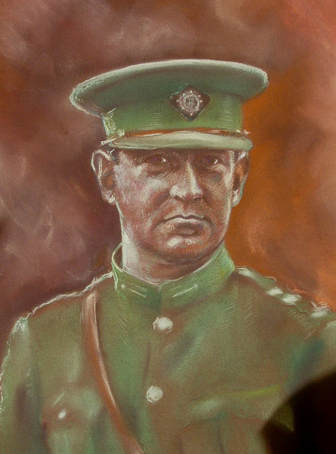
On the flight from Dublin to JFK airport in New York, I watch Neil Jordan’s Michael Collins. I’ve watched it at least twice before but that was years ago. On reviewing it looks at times a bit hammy. Alan Rickman’s portrayal of de Valera gets the voice just right but beyond that we have a scheming liar who sends Collins to negotiate the treaty and then denounces him for the inevitable failure of the Treaty terms.
Liam Neeson does a good job with the restless, daring Collins and Julie Roberts as Kitty Kiernan is as impressive as a tailor’s dummy. And while the brutality of violence is stressed, it still has a technicolour glory that is absent from The Wind That Shakes The Barley, one of the best movies ever made about the early Troubles.
Michael Collins was made in 1996 – twenty years ago. Could it have been made today? Possibly but more likely not. There is a lack of ambiguity about why the Civil War was fought. There’s mention of the oath of allegiance to the British monarchy but far more emphasis is put on the failure to liberate the north. Would the powers that be have allowed such a thing to interfere with their anodyne presentation of the Easter Rising commemoration? Not a chance.
One other thing I notices as we approached Kennedy Airport. The map on the little screen for viewing showed an increasingly detailed map of the places around New York. It’s something that I suppose all empires do – stamp their name on the places they’ve conquered. New York itself, of course – forget New Amsterdam. But then Berkshire and Bolton and Bradford and Bristol and Cambridge and Chester and Colchester and Coventry. And we’re still only at the Cs. Did the early colonialists give the new towns these names so they had a sense of home for them, or so that it was clear to all that their name – from England – was there to show that they had now taken over? Maybe a bit of both, but it shows you that Belfast’s not alone in its Royal Avenue and King’s Hall and Queen’s Bridge and Prince Charles Way. Of course, the Americans at an early stage made it clear that they wanted the English out, and their violence didn’t end with dumping tea in Boston Harbour.
Interesting if useless fact: Did you know that one of the small New York towns is called Hicksville? If you didn’t laugh you’d cry.
He will remain a hero of mine, they will not take that from me.
Perhaps Collins might have agreed with Marx’s analysis that, all proper tea is theft. For many of us drinking a hot cup of tea is a relaxing and enjoyable experience. We tend not to think about slave traders and young children working on tea plantations.
What might Collins make of all the fast food proclamations with coffee to go in Baile Átha Cliath in 2016? Take away burgers are getting as rotund as are some burghers, although those living off the fat of the land tend not to frequent des établissements de restauration rapide.
Would Mick appreciate the 24/7 spectre of consumerism, complete with paddywhackery, parochialism, celtic kitsch and a ‘buy one get one free’ ethos as commentators, with no time to breathe blurt out,
“T.s and C’s apply?”
Terms and conditions, cui bono?
Collins died at 31. All ifs buts and maybes…had he lived, I don’t think he’d be enjoying his current status of beatification in Irish history.
According to Tim Pat Coogan , Dev said he needed scapegoats so off they went to London to meet up with Lloyd, Winston and friends one of whom may have been named Carson.
And what do Billy Joel and Lorraine Bracco have in common?
I think the film although not perfect is still a pretty good representation of the time. Confused British troops, thuggish Black and Tans, collaborating RIC men. Rickman made a decent fist of Dev and we have to remember an hour and a half is not a lot of time to get the full story across. The scene at the end with the young messenger is a bit weird, did that happen?? I think if the staters made a film about Collins today the north would be air brushed out of the picture.
Who are these shadowy ‘powers that be’ who exercise such control over the Hollywood film industry? We must assume they have controlled all the output about the rising in recent times to ensure it has been suitably anodyne?
Could it be Fine Gael in collusion with Fianna Fáil? Almost certainly.
And the zionists I would safely say too, though I’m not sure why.
Look out too for “Ulster County” , Jude..and of course “Orange County”…
I’d love for someone to do a study of all those Orange counties, I wonder how many of them are of ‘Ulster’ heritage?
Speaking of which, if I understand correctly the North Island of NZ was once called New Ulster. It went from ‘New Ulster’ to ‘North Island’, any wonder I felt at home down there!?
The USA is an ex-colony run by former colonists, as is Australia and Canada. Indeed, every country where English is used as an official language is at present or has been at one time a colony of England. These places still have there own languages and customs even though they are completley over-shadowed by the dominant one-fits-all mono-culture.
their*
“Did the early colonialists give the new towns these names so they had a sense of home for them, or so that it was clear to all that their name – from England – was there to show that they had now taken over? Maybe a bit of both, but it shows you that Belfast’s not alone in its Royal Avenue and King’s Hall and Queen’s Bridge and Prince Charles Way.”
Well, I suppose.
That was the fashion back then; New France, New Spain, New Holland and in the American North East’s case ‘New England’.
(There’s a Londonderry in New Hampshire too methinks)
With regards to NI and having the name of the invader ‘stamped’ on everything have a look at this, it’s the 50 largest towns in NI; https://en.wikipedia.org/wiki/List_of_localities_in_Northern_Ireland_by_population
At most there’s 15 towns there with English names (and even then some of them they tend to be hybrid names) and that doesn’t include townland names which are nearly always local names (this can be demonstrated on the Orange Order’s banners in rural lodges).
And if we look at the biggest unionist towns we have the following:
Carrickfergus, Ballymena, Ballymoney, Ballyclare, Larne, Bangor, Portadown, Lisburn, Banbridge.
Hardly an English name among them.
And if I could point out, these regal street names that you mentioned were put there by Irish people.
Yes, Protestant unionist Irish people, but Irish people nonetheless, I don’t think it’s right to give the impression that Royal Avenue was foisted upon a reluctant population by foreigners, it wasn’t.
It’s a fact of history that the unionist movement back then was an Irish unionist movement (which of course mutated into today’s British nationalist unionist movement).
And as for the Americans wanting the English out, that’s not 100% true;
what’s NOW known as the US (or more specifically it’s north-eastern part) wanted the Crown out, the colonies further north did not and thus became Canada.
A war, an arbitrary border line, northern loyalists and Orangemen – it sounds quite familiar doesn’t it?
Great stuff Am Ghob…well observed…
Thanks Paddy, but don’t be telling too many unionists that otherwise there’ll be a mass of re-naming and paint attacks on town signs… “Larne?! You mean ‘Oldfleet!!!!”
The early settlers from England and Scotland did not want to change the placenames in Ireland because the new names had no legal status and therefore it would be impossible to prove ownership of the land. You made some very good points in that post. None the less, names like Kingstown, Queenstown, Suffolk, Yorkgate, Queen’s County, King’s County did replace the native Irish Gaelic names previously given to these places. Names that were an intregal part of the history of Ireland, Dún Laoghaire, the fort of Laoghaire (High-king of Ireland). The anglicisation of the placenames in Ireland together with language loss has made it very hard for us to decipher some of our own placenames. Dinnseanchas, the study of placenames being an intregal part of Irish culture. A new naming culture which has emerged in recent times is to name estates and housing developments after the trees, shrubs, historic buildings which once stood there before the houses were built – Oak grove, Old Mill Grange, Kiln House ect ect. Either that or take part of the townland, placename, like the Ring of Gullion – How would you translate that into Irish? Fáinne Cuilleann? Fáinne Shiabh gCuilleann? In Galway we have the place Roundstone – probably one of the more revealing examples of the motive that lay behind the process of anglicisation Cloch na Rón – The Stone of the Seal – the element rón being rendered as ’round’. On the Liffey bridge in Dublin we have Ireland’s major rivers – The Boyne, Liffey, Shannon and Bann being represented as bearded men. But anybody that knows anything about Irish topography would know that these river names are feminine in origin An Life (a feminine name of a plain) an Bhanna (< Bandía Goddess), Bó Fhinn (white cow), Sionann (grandaughter of Lir). The point I’m trying to make is that Ireland did go through a process of colonisation and that language shift and cultural obliteration was a part of this. This cultural obliteration continues today in the form of habitat loss as the towns slowly eat up the countryside and alien placenames are imposed on these new developments. In the south of Ireland many councils have decided to name many new housing developments in Irish. But this is part of the same process albeit less damaging to the language itself. Language is still too hot a topic in the north for some. To even put a poster up in Irish is taboo in some circles regardless of religion. This year we have heard lots of bluster about 1916 and the wars that followed it as if Ireland is only 100 years old. Within the Irish langauge and Gaelic culture the true history of Ireland is revealed. That is a culture that has 1500 years of written records. Language loss stands between us and our true history.
Fáinne Shliabh gCuilleann*
(Some corrections) Cloch na Rón = Stone of the Seals. And the faces depicting Ireland’s rivers are on The Custom House in Dublin.
It’s a good poem though, ‘the naming of parts’ I half remember it from school;
“and the point of balance, which in our case we have not got”
Paddy probably knows it as it’s got bees in it!
Strangely enough gio, I hadn’t thought about it for many long years .Always good to be reacquainted with a distant memory though.