
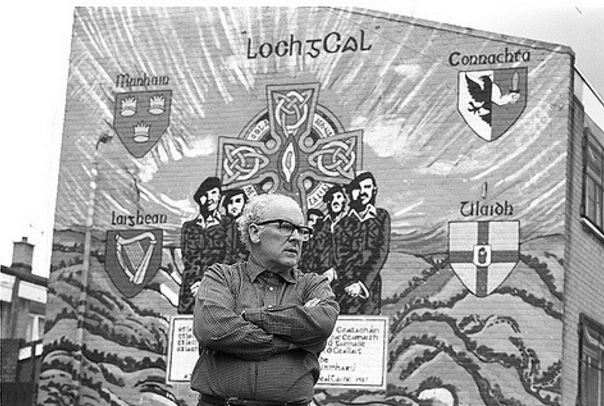
I went to see a play in the Conway Mill during the Feile in West Belfast recently. The title was ‘Connolly v Kane’ and it was written by Fr Des Wilson who is already 91 years young. It was most unusual and most interesting. I strongly recommend it. The background may need a little explanation.
Des has always been fascinated by Irish history especially the history of the Church and socialism and republicanism. In his own life-time he has seen the resistance to change and to radical ideas in the Irish Catholic Church. Churchmen who strongly opposed republicanism were and are adulated in the media. Fr Des wanted to do something to commemorate the 1916 Rising and also something that would rekindle a debate. He got this idea to re-enact a great debate which occurred in 1910 between the radical socialist, James Connolly, and the right-wing Jesuit priest Fr Kane. The debate was not face to face – but was carried out in writing. It resulted from a series of talks that Fr Kane, who was blind, was asked to give during Lent 1910 in Gardiner St. Jesuit church. James Connolly, the Trade Union organiser read the transcript of these talks and wrote a series of replies which were later published under the title “Labour, Nationality and Religion”.
Fr Kane used the opportunity of the Lenten talks to denounce socialism and communism and James Connolly. Socialism, according to Kane, was evil and completely anti-Catholic and he used the statements from Pope Leo XIII to support his arguments. It was a fascinating debate at the time and in Fr Des’s reproduction, taking the most relevant sections of the published material at the time, it is even more interesting today. It raises serious questions about the liaisons the Catholic Church (meaning clergy) formed with the rich and the state and the right wing parties of the time. It challenges the Church’s interpretation of the gospel preached by Jesus the carpenter. At this juncture we are able to take a broader view of the times and put them in their European context.
These two men had two totally different understandings of democracy and socialism. The play puts the whole debate in a wider European context. Ever since the French revolution, the Catholic Church was totally opposed to radical and republican ideas, The play shows that you cannot ignore the radicalism in other countries, the writings of Karl Marx and Fred Engels, nor can you ignore the revolutionary ideas that were floating around in Europe at the time leading up to the 1916 Rising. James Connolly was greatly influenced by these radical ideas about socialism and he was greatly moved by the poverty he saw in Edinburgh and later in Dublin and Belfast. All of that inspired him to form a Citizens Army and join in the 1916 Rebellion. It cost him dearly. Nor can you ignore Fr Kane’s upbringing and education in a Catholic middle-class family in Dublin and especially his experiences in Paris during the 1848 rebellion. He believed he was defending the teaching of the Church as he saw and understood it.
The play brings out the enormous class divide and the gap in understanding that existed and still exists in Ireland. It shows how the official church took the wrong side and lost the working class. It may be true to say we understand a little better these days but the system that separates rich and poor is still in existence.
The play was presented by two women and two men associated with Springhill Community House and was introduced by another friend of Fr Des, Eilis Rooney. Des himself did the sound effects. There were over 100 present-mostly old friends and activists. It was a tour de force. I hope that everybody gets a chance to see it or read it. You will gain a better understanding of our history and of the unhappy relationship between Church and state. It could help to reignite that debate again in a more relaxed and respectful atmosphere. It is certainly a debate that is much needed.
Wher can you get a copy to read?
Connolly was physically atttacked in Cobh for the temerity of his reply to Father Kane.
Another Jesuit, Father Shaw attacked the 1916 insurgents in 1966.
The Sunday Press used carry a weekly column by a Father Knox SJ which once had a piece saying that if you said “BOO” to a revolutionary he would collapse. So far as I can remember a hunger strike had just started.
Another Jesuit wrote a short study of William Martin Murphy. I;m willing to believe that Murphy was a strong courageeous character. But he belived it was the business of bosses to order and workers to obey.
But the Jesuit tells us that Murphy used ptay for Connolly. The Jesuit referred to Connolly
as a “Martyr” in inverted commas. If that Jesuit is not in Hell I do hope he spends a long time
in Purgatory.
I don’t think he would have had any truck with Liberation Theology.
And then there’s Seumus Murphy SJ, an Apostle of NEOCON MILITARISM and a cornerboy
sneerer at Pearse and Connolly.
Fr. Des is a jewel and as you have seen a very talented person. Very few who have a better insight to the conflict in the North. I was one of many Americans that contributed to his work at Conway Mill through Doors of Hope. I hope someone on this side of the pond picks up the idea of his Debate re-enactment. Joe Jamison would be my best bet for that. Thanks for the post Jude.
Failte romhat, Mike – although it was Joe’s blog…