
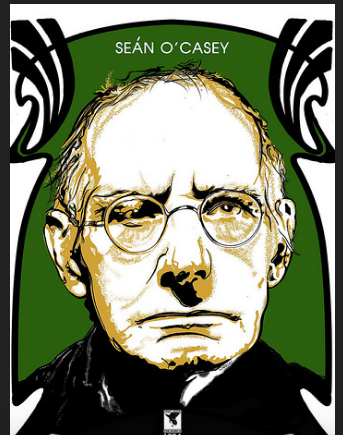
THE IRISH WORLD (London) on August 13th carried a piece by one Mick McDonagh publicising the staging in London of Sean O’Casey’s “THE PLOUGH AND THE STARS”.
I suspect Mick MacDonagh was not about in 1966 and has done no research on 1916 nor even on 1966. He cannot possibly be a true revisionist. He appears to have parroted the canard that in 1966 the Irish populace mindlessly glorified the 1916 Insurrection and its participants, and had forgotten the participation of their compatriots (their own fathers, brothers and uncles!) in the First World War.
Mick MacDonagh appeared to think that Sean O’Casey was a John Bruton born before his time, whereas O’Casey despised John Redmond and the Irish Parliamentary Party and wrote at least one song lampooning recruitment for the British Army.
O’Casey, for whatever reason took no part in the 1916 Rising, although he had helped organise the Irish Citizen Army which had a central and heroic part in it. His sneering treatment of it ten years later followed the national heartbreak of the Civil War. Those who protested at its first performance included Hanna Sheehy Skeffington, one of the most intelligent women of her generation and Frank Ryan, a hero of the International Brigade in the Spanish Civil War.
The following is the full text of my letter to THE IRISH WORLD, part of which was published this week in it, for which I thank its Editor, Bernard Purcell.
(BLOGS don’t take up precious hardcopy space)
“It is 100 years since the 1916 Rising and the great difference between 1966 and 2016 is that fifty years ago a great number of people in Ireland could remember Carson’s Volunteers, the 1913 Lock-outs and the constabulary breaking the heads of Dublin Workers, the First World War, the 1916 Rising, the establishment of Dail Eireann, the Black and Tan Teror and the Civil War. There were still many people in Government, Opposition, the Civil Service, the Trade Unions and the media who had played parts in those cataclysmic events and had had decades to reflect on them. Not so today.
Mick MacDonagh (Aug 13) would have me believe (I was born in 1941) that in 1966 there was “a macho mythologised tone to the 1916 commemorations.” Really?The Government was led by Sean Lemass, who had been forward-looking as a teenage insurgent, a forward-looking realist in defence of the first Dail, forward-looking in urging de Valera to found Fianna Fail after the debacle of the Civil War, and forward-looking in the various Cabinet posts he had held since 1932.The Minister for External Affairs was Frank Aiken, who, since he ordered the IRA to put their arms in secure dumps and ended the Civil War, had played many constructive roles, including with the United Nations where his efforts were crowned (in 1968) with the Nuclear Non-Proliferation Treaty.Younger Ministers, many of great ability, had joined the Cabinet the year before. Ireland was looking forward but knew whence she had come.
Mick Mc Donagh regards Sean O’Casey’s “Plough and The Stars” which in 1926 cast a sneering light on the 1916 insurgents in as “prescient.” O’Casey had been prominent in the Irish Citizen Army and left after a tiff with Countess Markievicz, and played no further political or revolutionary role. Markievicz played a useful role in founding Fianna Eireann, a humanitarian role feeding the children of locked-out workers in 1913, a heroic fighting role in 1916, was elected to Dail Eireann in 1918 and became, as Minister for Labour, the first woman Cabinet Minister in Europe. When she died, in 1927, she had a huge funeral, mainly of the Dublin poor whom O’Casey spilt so much ink over. A much more impressive funeral than the top-hatted one of the assassinated Kevin O’Higgins a few days earlier.
Perhaps the most prescient piece written between the 1916 Rising and O’Casey’s play was written by Britain’s Lord Lieutenant in Ireland, Lord Wimbournenon 14 July 1917, in confidence to the British Cabinet –
“The Sinn Fein victory in East Clare is a fact of cardinal significance……It marks the definite failure of the policy to rehabilitate constitutional nationalism or disarm Sinn Fein defiance of English rule…..In a remarkably well conducted political contest by excellent candidates on both sides, the electors, on a singularly frank issue of self-government within the Empire versus an independent Irish Republic, have overwhelmingly pronounced for the latter.”
The British Government kept that document secret until 1967 by which time the winner of the East Clare by-election had led Sinn Fein to general elections twice, Fianna Fail into government following eight general elections (after which he ran two successive seven year laps of honour as President of Ireland. Along the way he had welcomed his defeated Redmondite rival, first into Sinn Fein, and later into Fianna Fail, and appointed him Attorney General.
In his memo to the British Cabinet Lord Wimbourne described Redmond’s Party as dead on its feet. I paraphrase here. In July 1917 also, the Royal Irish Constabulary reported – “All talk among the young is of the ‘Republic’ “.
Many revisionists would have us believe that in 1916 Ireland was enjoying peace under a loving British Government when a bunch of wild fanatics with a death-wish spoiled everything.Though the revisionists are many their evidence is scarce.
In 1912 James Connolly and James Larkin founded the Irish Labour Party intending to put forward candidates for a Home Rule Parliament. Wealthy men in London, Belfast and Dublin financed a private army trained by British officers and backed by Conservative politicians to ensure there would be no Home Rule. In 1913 police in Dublin broke the heads of Dublin workers and Connolly and Larkin took a leaf out of Sir Edward Carson’s book and formed the Irish Citizen Army, armed mainly with hurleys. In 1912 Patrick Pearse, whose main interest was education, shared a platform with John Redmond in support of the popular demand for Home Rule.
And in 1914 without an election, the British government committed Britain, Ireland and the British Empire to war. By the time of the Rising Carson and his cronies had joined the British cabinet. The general election due 1915 was, like Home Rule, kicked into the long grass while young men were turned into cannon fodder. Redmond had no mandate to commit Irishmen to war.To give Sean O’Casey his due he never supported John Redmond and he attacked recruitment to the British forces. If Mick MacDonagh sees O’Casey as a John Bruton before his time, I’d suggest he go to Specsavers.
The Irish electorate from 1917 until the the rise of the revisionists didn’t need Specsavers. The hearts, minds and souls of the Rising were sane and sound.
The headline for the BLOG is a transcription of the headline in THE IRISH WORLD to Mick MacDonagh’s nonsensical article.
We could do with more of the same hearts, minds and souls today Donal
Very interesting, Donal. It never ceases to amaze me how Irishmen can continue to be ashamed of their own, legitimate fight for freedom. These people would die off if an Irish-style 4th July were suggested. That sneaking regard for the British Empire and the inherent forelock-tugging it precipitates, overrides the pride most other nations would have in controlling their own destiny.
I long for the day we have our own independence day Freddie
I would also like it to be held on Easter Monday