
This is a section from a forthcoming book on the Easter Rising and its aftermath by Donal Lavery – Jude
– ”You claim to be a Majority, well you know that’s a lie! You really are a minority on this Sweet Emerald Isle”
(lyrics from the song ”Bloody Sunday” by John Lennon)
In his book, ‘The British in Ireland’, Geoffrey Bell made reference to the Bloodbath Theory on Northern Ireland’s Loyalists, stating that ”besides religion, the one thing they share in common is the desire to be excluded from a united Ireland.” Bell went on to say that ”the wish of a minority to evade majority rule is not something which finds much sustenance in democratic principle. Especially when the motivation is a desire to maintain economic and social ascendancy over the majority of citizens.” But how did this ”Carnival of Reaction” really emerge over time? The Irish Nationalists, caucusing with the Liberals at Westminster, were let down by successive British Governments which they helped empower. British democracy was consistently subverted, in the form of non-elected peers sabotaging the very modest attempts to legislate for Home Rule in Ireland. In the words of David Lloyd George, the House of Lords was no longer the watch-dog of the Constitution, but rather ”Mr. Balfour’s Poodle.”
When the Home Rule Bill finally passed it was delayed, in which time and beforehand Edward Carson and James Craig seized the opportunity to arm and finance a Loyalist counter-insurgency in the North-East counties of Ulster. Using arms provided by the foe (Imperial Germany), Carson made clear to the British Government that any attempts to set up a parliament in Ireland would be met with High Treason in the form of Orange terrorism throughout Ireland, Britain and the Empire. Winston Churchill, due to be speaking in favour of Home Rule to a gathering of Ulster Liberals in the Ulster Hall in Belfast, had to deliver his oratory elsewhere as a result of Loyalist intimidation. It takes little by way of imagination or providence to predict what would have happened if Nationalists or Republicans had prevented a British Cabinet Minister, let alone the Home Secretary, from facilitating a speech in a key industrial city within the Union. As Connolly observed, ”You know Mr. Churchill would have made that meeting.”
Egged on by large bourgeois industrialists in the North-East counties and the Right-Wing of the Conservative Party, the ‘Orange Aristocracy’ established contingency plans for a Provisional Government should Home Rule be granted. Showing that they were willing to betray the Irish some more, Lloyd George gave written assurances to Carson that the majority of Ulster counties would be excluded from any devolved settlement, while Asquith invited the Unionists to occupy key positions in his war-time administration; the very Government the Unionists had been arming and encouraging a revolt against.
Instead of facing down the threats of Orange terrorists and the Tory Right, including bringing those responsible for the Curragh incident before a Court-Martial, the British Government directly capitulated to it, undermining the democratic will of their own electorate to appease the sedition of Right-Wing extremists who had been consistently rejected at the ballot-box. Imagine how this must have looked to any ”decent, law-abiding citizen” in Ireland at a time when thousands of their fathers and sons were being slaughtered on the fields of France for the very Government so willing to betray them!
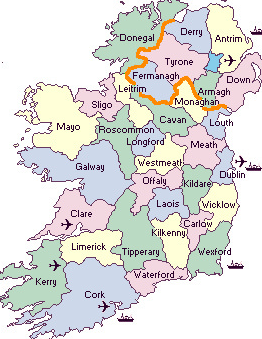
When the negotiations between the British and Irish finally took place after the Rising and Tan War, Lloyd George played the Irish plenipotentiaries against one another, holding the carrot that was a promised Boundary Commission which would make Northern Ireland unviable as a state, yet wielding the stick threatening ”immediate and terrible war”, should they refuse to accept the Treaty being imposed on them. After the Treaty was signed, a most bloody and bitter Civil War ensued in Ireland, turning brother against brother, with the added insult of no measurable changes being decided upon by the Boundary Commission. What followed included the establishment of an illegitimate state-let in six of the Ulster counties (Fermanagh, Down, Tyrone, Antrim, Armagh and Derry), which despite a natural built-in Unionist majority, presided over a systematic gerrymandering of electoral boundaries to reward the Unionists with continuously large seat numbers in a parliament already favouring them.
‘Northern Ireland’ thus became synonymous with routine discrimination against the Roman Catholic population, draconian ”emergency legislation” (the ‘Special Powers Act’, much admired by the Apartheid Government in South Africa) to crush any perceived opposition to the state, and the arming of Unionist death-squads in the form of the police and military. Within all of this, history bequeaths a number of ironies; Firstly, Carson had opposed partition almost as much as Home Rule; When the Founding Father of the state was offered the Premiership of it, he declined; Describing the speeches of Northern Orangemen, Carson stated how they reminded him of ”the unrolling of a mummy. All old bones and rotten rags”; Opposing any compromise on the Irish question, particularly a half-way house between full membership and place in the Union, he demanded that ”Ulster be given a resolution rather than a stay of execution.”
Repulsed by the compromise that became the Anglo-Irish Treaty of 1921, Carson attacked the ‘Tory intrigues’, who had provided the impetus for partition, claiming ”What a fool I was! I was only a puppet, and so was Ulster, and so was Ireland, in the political game that was to get the Conservative Party into Power.” Knowing all too well that partition was economically and spiritually detrimental to both regions of Ireland and the concept of Unionism, Carson sensed betrayal over the Tory willingness to cut loose twenty six of Ireland’s counties, most of whom elected Parliamentarians who would never caucus with them. . To him, this was not a battle for the principles underlying the Act of Union among idealists, but merely a drama of electoral arithmetic acted out by one set of elitists wishing to oust another set of elitists.
Moreover, analysing how unstable the Northern state would become if its one third (and growing) Catholic population sought to destroy it, Carson proselytised ”We used to say that we could not trust an Irish Parliament in Dublin to do justice to the Protestant minority. Let us take care that that reproach can no longer be made against your parliament, and from the outset let them see that the Catholic minority have nothing to fear from a Protestant majority.” Another irony of it all is that Northern Ireland did not have to become the ”cold house for Catholics” it became infamous for. After all, it was never a fully self-governing Dominion. It was not a sovereign parliament within the Empire, rather a devolved parliament within the Union, so all of the abuses so infamously associated with the state apparatus and society of Northern Ireland could have been prevented by a sovereign Government at Westminster simply refusing to ignore or disregard the precarious affairs of a member-state within the Union; If the rights of Catholics in Northern Ireland had been subjected to the same standards as those enjoyed by Catholics in England, the bloodshed of the Troubles may well have been avoided.
The Conservative Party has always positioned itself as the force for ”law and order” in the land, with a strong militarist and imperial-minded faction therein. To say nothing of the Tory betrayal of the Unionists then, we need only look at the actions of successive Conservative Governments in the 1970’s and 80’s; It was Edward Heath’s administration which prorogued Stormont, which introduced ‘Special Category Status’ for political prisoners, who set up the power-sharing Sunningdale Executive and who negotiated directly with the IRA leadership regarding potential solutions for the Northern Ireland problem, including the possibility of a British withdrawal. Margaret Thatcher re-introduced ”political status” in all but name following the Hunger-Strikes after the Labour Government ended it, while also ensuring that there would be no return to a Unionist-dominated Stormont when she signed the Anglo-Irish Agreement with the Dublin Government in 1985. The Tories, true to form, were openly discussing the future of Northern Ireland against the clear wishes and without any consent from the Unionist Establishment. Likewise, it was agents of the Thatcher Government who instigated talks with the Provisional IRA, which later became the peace process. John Major’s Government made clear that the British had no special or economic interest in remaining in Ireland, with the Downing Street Declaration laying the foundations for Tony Blair to conclude the Good Friday Agreement.
Significantly, the party which talks most emotively and fondly of the Union has always been prepared to rid themselves of it where Northern Ireland is concerned. Having always aligned themselves with the Conservatives, the Unionists have found time and time again that it is the Tories who are most willing to politically stab them not in the back but in the front. The individuals who understood this more than anyone else were the Provisional IRA leaders, for when they bombed Canary Wharf (the London financial district) while a Conservative Government was in power, they brought about the beginning of the end of the connection with Britain simply through costing the Westminster Exchequer too much money to maintain the status quo. Ian Paisley was later to remark in an interview that the main reason he conceded the Saint Andrew’s Agreement and power-sharing with the people he had so solemnly denounced over the years, was because of the existence and threat from the British Government of a ”Plan B”. Notably, this ”Plan B” which Paisley anxiously spoke of included moves towards Joint Sovereignty of Northern Ireland between London and Dublin and eventual reunification of the island based on common accord between two sovereign Governments and European Union member-states.
What are now the facts of history are relevant to the hypothesis of this book, which envisages what sort of Ireland would have emerged if the Easter Rebellion had been triumphant. For we know, that Lloyd George’s threat of ”immediate and terrible war” ended up happening anyway, with the flooding in of British Troops to Ulster and a plethora of casualties, suffering and cost over the years. But let’s reexamine the position of the Unionists during the Home Rule crisis; the resistance to Home Rule was led by what Connolly labelled the ”Orange Aristocracy”, made up of bourgeois capitalists in the North-East counties, fearing that a devolved or independent Irish Government would impose taxes on them to pay for the increased living standards of the rest of Ireland’s population. To that end, the Capitalist Class in Ulster used their surrogates in the Loyal Orders to whip up unrest to portray what was actually a class issue, as being a distinction and defining difference of religion and nationality. Accepting arms from Britain’s war-time enemy, they issued a hollow threat against the very capitalist, sovereign Government at Westminster, who guaranteed their commercial assets and enterprise. This was a threat they simply could not substantiate in any meaningful way, for if the British Government had withdrew from Ireland after the Rising and had the Unionists tried to facilitate their contingency plans, then any Westminster Government would have been in the commanding position of being able to impose trade restrictions and barriers on the business interests of the middle and upper-class Unionist elite who were leading the promised revolt.
This British resolve, in the form of a refusal to engage in ”business-as-usual” with the Unionists and their industries, would have been coupled with the threat of a much larger, counter ‘standing army’ in Dublin (in the form of a united Irish Volunteers), disciplined and eager to see their country thrive among the nations of the world. In which case, the Unionist Establishment would have been forced into encouraging the Loyalist masses to make the best out of any prospective united Irish state, including aiming for a secular and pluralist constitution that would afford them the religious safeguards and equality which they had so denied the Catholics for centuries. Britain exiting Ireland would have been the ultimate guarantee that the Protestants, Unionists and Loyalists would have to reach some sort of cordial and workable relationship with their Catholic, Nationalist and Republican neighbours, if either community was to prosper in the world. And after this had been established, Connolly’s prediction that the Loyalists would have to rally around the politics of class and not nationality, would have added a driving force to the pursuit of socialism in Ireland, especially given the size and scale of the disciplined Northern proletariat in the industries of Belfast and Derry.
The most likely alliance following a British withdrawal after a successful Easter Rebellion would actually have come in the form of the Catholics and radical Presbyterians/Non-Conformists, engaging together to garner the ‘political muscle’ to obtain, at minimum, some sort of Scandinavian-like Social Democracy in Ireland. The Presbyterian majority among the Protestants would have reminded themselves that it was always the High Anglicans who discriminated against them in times gone by, playing the race and religion card to crush the prospects of socialism among the working-class in Ireland. In the mainland of Britain, the Non-Conformist sects have generally been the most timeless advocates of the necessity of British socialism, with the vast majority of Labour Prime Ministers having been either Congregationalists or Scottish Presbyterians. There was a consensus among such people that socialism in Britain ”owed more to Methodism than to Marx.” This radical tradition of dissent among the non-established churches could very well have been awakened in the poverty-ridden, cobbled lanes of the Shankill Road, Sandy Row and the Water-Side, with their Dickensian levels of deprivation and economic misery. It would, after all, have been highlighted to them that Redmond and Craig were of opposite religious backgrounds (Catholic and Presbyterian) yet both supported the Imperial-Capitalist economic system in Ireland, as well as an expanding Empire abroad.
Politically, the Unionists and Loyalists would likely have split along class-lines in an independent Ireland, with the former establishing a corporatist, right-wing party (like early Fine Gael), and the Loyalist masses opting for a social democratic-type Labour party, to get working men and women into parliament. Moreover, some of the more economically conservative of the Redmondites, Nationalists and Republicans, given their petty bourgeois leanings, may have joined forces with the Unionist professional classes to collate together a collective of vested interests supporting a capitalist hegemony in Ireland. No rogue’s gallery can be ruled out, for stranger ironies have occurred throughout history.
Undoubtedly, this chapter may surprise some, many even. There will be readers, particularly those of a hard-line Unionist or Loyalist disposition, who will outright dismiss such possibilities. But given the vast dismantling of the ‘Orange State’ which has continuously occurred these past several decades, the question must be asked, if they are capable of such a revolt then why haven’t they staged it already? Why have they allowed the British Government to impose on them mandatory coalition and power-sharing, with the very people who tried for years to destroy their beloved state-let, until there is a fundamental and irreversible change in the constitutional position of Northern Ireland within the Union, to which there is no going back?
The Ulster Worker’s Strike of 1974 was in many ways the last mobilised stand of organised Unionism, for they revealed their hand and successive Direct Rule Ministers sought to legislate in ways that would prevent any such repeat of the action witnessed during that dramatic episode. For one, many more Catholics now occupy high office, the state-sector and dominate the professions which make up the Northern Ireland economy, with higher standards of educational achievement in a globalised world which does not recognise racial or religious distinctions. The rise of ‘Thatcherism’ and the free market destruction of heavy-industry has left the Loyalist masses of Northern Ireland without any natural power-base in the economy, as well as no sectarian dominated trade unions in which to mobilise. Given all that has come before them, the Unionist leaders may be dealt the final blow from the corridors of Westminster in the form of a Conservative Government, who despite the rhetoric of ‘One Nation’, no amount of emotive speeches from Northern Ireland MP’s will garner any real loyalty from. So although the hypothesis this book outlines is concerned with what would have happened if the Rising had succeeded, the inevitable consequences for the Unionists then in such circumstances may still very well happen tomorrow; for as the Provisional IRA stated to the Thatcher Government after the Brighton Bombing of 1984, ”We only have to be lucky once. You have to keep being lucky every time.”
Was this composed on the Isle of Wight? Who else talks of ‘mainland Britain’? Apart from a few such minor gaffes, this is a factual, comprehensive piece.
What a dreadful book this appears to be. Worse than a Tim Pat Coogan. Entirely unbalanced and relies as a premise on an ancient account riddled with factual innacuracies, and a patronising Marxian analysis borrowed from Connolly, before engaging in whimsy and wishful thinking.
Some observations.
Every people is a minority if you draw the boundaries so as to make them so: Irish nationalists were a minority in the British Isles. They wanted to evade ‘majority rule’ as much as unionists did.
Ulster unionists, of course, were a majority in north-east Ireland and deserved to have their sslf-determination facilitated as much as did Irish nationalists. All peoples should be treated equally and afforded the same rights.
“Using arms provided by the foe (Imperial Germany)”
The arms were purchased from a private dealer.
“Carson made clear to the British Government that any attempts to set up a parliament in Ireland would be met with High Treason in the form of Orange terrorism throughout Ireland, Britain and the Empire.”
I am quite sure this is untrue.
“to appease the sedition of Right-Wing extremists who had been consistently rejected at the ballot-box.”
Unionists weren’t right-wing extremists and hadn’t been consistently rejected at the ballot box. In fact they had won the majority of Ulster votes.
“After the Treaty was signed, a most bloody and bitter Civil War ensued in Ireland, turning brother against brother, with the added insult of no measurable changes being decided upon by the Boundary Commission. What followed included the establishment of an illegitimate state-let in six of the Ulster counties (Fermanagh, Down, Tyrone, Antrim, Armagh and Derry), which despite a natural built-in Unionist majority, presided over a systematic gerrymandering of electoral boundaries to reward the Unionists with continuously large seat numbers in a parliament already favouring them.”
Northern Ireland wasn’t illegitimate and wasn’t established after the Civil War. It was established a year before the Civil War began. Gerrymandering wasn’t systematic, but restricted to a small number of local government boundaries, notably Londonderry. Interestingly the nationalist Newry council also engaged in gerrymandering. It is a lie to suggest that parliamentary boundaries were gerrymandered.
MT unionists did not winthe majority of ulster votes. for as far back as 1886 nationalists held 17 seats in ulster and unionists 16. that then was the reason only six counties were chosen for the partitioned statelet. and may i remind you that even then Fermanagh and Tyrone held nationalist majorities. Your nitpicking is becoming increasingly boring as is the whole unionist negative project
“MT unionists did not winthe majority of ulster votes.”
Yes they did.
“As for as far back as 1886 nationalists held 17 seats in ulster and unionists 16”
We’re not discussing 1886.
“. that then was the reason only six counties were chosen for the partitioned statelet. and may i remind you that even then Fermanagh and Tyrone held nationalist majorities. Your nitpicking is becoming increasingly boring as is the whole unionist negative project”
I’m well aware why six counties were chosen and about Fermanagh and Tyrone. It doesn’t alter the fact that the majority in Ulster voted for the Union.
You call it nitpicking. I call it accuracy.
“Irish nationalists were a minority in the British Isles”
The British Isles is not a country MT, it is a group of islands which individual countries reside.
Ireland as in the whole island is one country, completely separate from the other countries on the other island who would also argue that they are separate countries also.
The link between all of these countries is the act of union, which is an agreement between individual nations who can undo the agreement. Ireland is a separate nation MT and England will not occupy any part of it for too much longer.
“The British Isles is not a country MT, it is a group of islands which individual countries reside.”
It was a country during the time under discussion. Not sure why that matters, though.
“Ireland as in the whole island is one country, completely separate from the other countries on the other island who would also argue that they are separate countries also.”
Depends what you mean by country. It’s also true to say Ireland isn’t one country, it’s two. Again, not sure why this matters.
“The link between all of these countries is the act of union, which is an agreement between individual nations who can undo the agreement. Ireland is a separate nation MT and England will not occupy any part of it for too much longer.”
Islands aren’t nations: peoples are. Ireland isn’t occupied by England and never has been.
“It was a country during the time under discussion. ”
No it wasnt
“No it wasnt”
Of course it was.
MT, it the british isles was one country, then what was the point in having a union of England and Scotland, Ireland ?
“MT, it the british isles was one country, then what was the point in having a union of England and Scotland, Ireland ?:
To create one country , obviously.
De Nile is a river in Egypt. Some of the contributors here sure like to swim with the crocodiles
MT,
I’m not trying to change the heart of some Loyalist knave steeped in ignorance and evident bias like you; your cavalier attitude towards facts and what constitutes “sedition” and “majority rule” let’s all readers see who has verified themselves according to fact. The ciriticisms of people like you let me know I’m on the right track, I hope it busts a nerve!
Yours sincerely,
Donal
“I’m not trying to change the heart of some Loyalist knave steeped in ignorance and evident bias like you; your cavalier attitude towards facts and what constitutes “sedition” and “majority rule” let’s all readers see who has verified themselves according to fact. The ciriticisms of people like you let me know I’m on the right track, I hope it busts a nerve!”
But I’m not steeped in ignorance: far from it, everything I have said is based in fact, whereas you have demonstrated ignorance with factual errors and a refusal to understand or acknowledge alternative points of view. Ironically this means that it is you who are biased.
You’re on the right track to an old-school polemic that will not be taken seriously by any historian.
But I think arming a paramilitary against the expressed wishes of the majority of MP’s (as Carson did) and against the behest of the sovereign Government, during war time, to threaten terrorism, counts as High Treason. Get the dictionary out!
As for “majority rule”, the expressed will of the Irish people in 1917 was for independence and the Liberals, who had won landslides on a manifesto for home rule, agreed to it but failed to implement it. I think that’s called fraud.
I don’t think you are worth addressing, I’m only saying this for others to see. People like you are so ignorant of the historical facts but the problem is more so that you cannot ACCEPT them. Anything which delegitimatises your “wee country” is a pill you just can’t swallow. That’s a very open-minded way of looking at the world, when English born singers in the Beatles were able to ascertain that Unionists are but a minority in Ireland, and when the silver bullet comes don’t be surprised if the Tories rid themselves of you and everything you hold dear for a leopard can’t change it’s spots.
“But I think arming a paramilitary against the expressed wishes of the majority of MP’s (as Carson did) and against the behest of the sovereign Government, during war time, to threaten terrorism, counts as High Treason. Get the dictionary out!”
But the majority of MPs expressly endorsed the UVF, and they weren’t armed during war time. When war came they signed up en masse to the Army.
“As for “majority rule”, the expressed will of the Irish people in 1917 was for independence and the Liberals, who had won landslides on a manifesto for home rule, agreed to it but failed to implement it. I think that’s called fraud.”
But the expressed will of the people in the north-east was for exclusion from home rule and the government essentially accepted that. The Home Rule Act’s implementation was delayed because of the war.
“People like you are so ignorant of the historical facts but the problem is more so that you cannot ACCEPT them.”
But I’m not. I do accept them. In fact I insist on factual correctness. Your posts are riddled with factual errors, which is one of the reasons I’ve responded to them.
“Anything which delegitimatises your “wee country” is a pill you just can’t swallow. That’s a very open-minded way of looking at the world, when English born singers in the Beatles were able to ascertain that Unionists are but a minority in Ireland, and when the silver bullet comes don’t be surprised if the Tories rid themselves of you and everything you hold dear for a leopard can’t change it’s spots.”
You come across as rather bitter.
That’s about it , Donal. For one example… Edward Heath , Conservative PM had a plan to disengage Britain from Northern Ireland … back in the early 1970’s .He thought at the time that it might take about fifteen years.
“.Former Ulster Unionist MP Lord Kilclooney(John Taylor) said Sir Edward did not have a favourable perception of Northern Ireland.
He said his decision to introduce direct rule had been “traumatic for the unionist population”.
“It was the first step towards the British government giving Dublin executive powers within Northern Ireland,” he said.
“The relationship between the UUP and Ted Heath was not good. His perception of Northern Ireland was one of distaste and he did not look kindly upon Ulster Unionists”
That’s all in the public record , but better than that, I remember it happening exactly like that anyway.Sometimes I wonder which source MT gets his version of history from.It sounds like the same kind of sources which provide the Creationist Crazies with their origiin and age of the earth.
The expressed will of the people of the 6 counties and Scotland didn’t count for much in the EEC referendum, did it?
MT,
I’m saying this to Jude and other readers because like I said you’re not worth addressing. You cannot divide up a country based on the inclinations of individual counties – does that mean Kent should have a Conservative Government but somewhere like Lancashire should have a separate Labour Government?! It’s an idiotic suggestion to form countries out of counties political views. I haven’t stated one inaccuracy and I challenge you and any other Loyalist mouthpiece to find some verifiable evidence of that therein. I went out of my way to source my points coherently so that people like you could not shout flaw.
You mentioned no historian will take me seriously while deriding one of Ireland’s finest historical writers – Coogan. I think what you mean is no historian of your subjective narrative, for several publishing firms have already expressed a keen interest in getting this book on the shelves – so clearly they think it’s fact based.
Stick to lighting bonfires and parading your “true blue” colours for the world to see, history and debating are clearly not your forte.
DL
“You cannot divide up a country based on the inclinations of individual counties – does that mean Kent should have a Conservative Government but somewhere like Lancashire should have a separate Labour Government?!”
Not sure what counties have to do with it, but you obviously can divide territory according to people’s wishes. It’s called self-determination.
People in Kent don’t want to be separate from the rest of England.
“It’s an idiotic suggestion to form countries out of counties political views.
Counties don’t have political views: people do. People’s views are the basis of democratic self-determination.
“I haven’t stated one inaccuracy and I challenge you and any other Loyalist mouthpiece to find some verifiable evidence of that therein. I went out of my way to source my points coherently so that people like you could not shout flaw.”
Yes you have and I’ve pointed them out here.
“You mentioned no historian will take me seriously while deriding one of Ireland’s finest historical writers – Coogan. I think what you mean is no historian of your subjective narrative, for several publishing firms have already expressed a keen interest in getting this book on the shelves – so clearly they think it’s fact based.”
No I meant what I said. And Coogan isn’t taken seriously by historians either. But what you’re offering is even worse than Coogan.
“Stick to lighting bonfires and parading your “true blue” colours for the world to see, history and debating are clearly not your forte.”
I’ve never lit a bonfire in my life nor taken part in a parade.
The fact that you feel.compelled to resort to stereotyping and personal abuse merely reinforces the view that you are a half-educated bigot.
Self determination!! Haha sweet and gentle Jesus! Self determination does not mean running cap in hand to another parliament for handouts it means determining your own destiny, economically and politically. This, it seems, is beyond unionist comprehension.
“Self determination!! Haha sweet and gentle Jesus! Self determination does not mean running cap in hand to another parliament for handouts it means determining your own destiny, economically and politically. This, it seems, is beyond unionist comprehension.”
Nobody said self-determination did mean running cap in hand to another parliament for hand-outs.
Well that’s exactly what unionism espouses
“Well that’s exactly what unionism espouses.”
No it isn’t.
Oh and the British Government regarded Carson’s behaviour as criminal because they issued arrest warrants for the unionist leaders and then retracted them when the local Orange militia that was the police force wouldn’t uphold them. So, I think that says a lot.
“Oh and the British Government regarded Carson’s behaviour as criminal because they issued arrest warrants for the unionist leaders and then retracted them when the local Orange militia that was the police force wouldn’t uphold them. So, I think that says a lot.”
Is there any evidence for this claim?