
There’s a story of an old curmudgeon,who, when he died,posed his good neighbours a conundrum. It was not right to speak ill of the dead, but they couldn’t think anything good to say either. Finally the local barber spoke his epitaph : “He was an easy man to shave.”
THE GUARDIAN’s correspondent in Ireland, Davis Hearst, reminds me of that barber. His obituary for the late Unionist MP Harold McCusker eschewed judgement, good or bad, on the man,but in deadpan style described his beliefs and political actions.
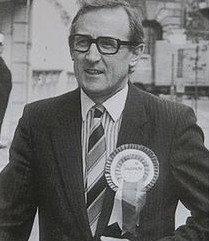
Mr McCusker died tragically of cancer at 50. Before emerging into the political limelight he was a teacher and a personnel manager. His pupils may have warm memories of him, as I have of a teacher whi became a Fine Gael Cabinet Minister,and those who worked under his management may remember him as a fair and good man. But my perception of Mr McCusker, from the media, is of a humourless and confused zealot.If Mr Hearst is to be believed, his confusion, as a phenomenon, was rib-ticklingly funny,but as a basis for political action lethally dangerous.
A few years back a newspaper showed a picture of Mr McCusker with a drum bigger than himself strapped on, marching down a street. It might be part of a “Two Ronnies” sketch , or a walk-on part of a Christmas show with Denis Healey, who knows how to play the fool without persuading the spectators to suspend disbelief. But not McCusker; he was beating the drum as if his very life depended on it. His parliamentary seat probably did, because, before and above being a politician, Mr McCusker considered himself an Orangeman.
McCusker said of the Orange Order:”For two hundred years it has been a unifying force and it is the only ecumenical organisation that I am interested in.” I hope he never taught history, for during its first 40 years it excluded all but Anglicans and still has five years to go to reach its bicentenary.
Curious too is the fact that Mr McCusker considered himself a Socialist, who in a real United Kingdom would have sat on the Labour benches in the Commons, (incidentally, isn’t the “United Kingdom” the real “failed entity” and isn’t “Northern Ireland” merely the most obvious sign of its failure?) – though Mr Hearst, like the barber above, is too charitable to note the irony. Let’s examine the Socialist tendencies of the Orange Order.
Explaining Orangemen to his fellow Russians, Lenin called them “Black Hundreds” equating them the bands of Czarist thugs who mounted anti-Jewish pogroms.
As against the Bolshevik view , let’s examine that of W.E.D. Allen*, an ex-Unionist MP* , in 1934 a member of Sir Oswald Mosley’s British Union of Fascists. In an article in the BUF magazine Allen described Carson as the “Leader of the First Fascist Movement in Europe.”
But Bolshevik and Fascist observers could both be wrong wrong and it is instructive to look at the record of Orangeism to see if there was anywhere within it the germ of a socialist, labourite,democratic or liberal approach to politics.
Its origins in the 1790s give little ground for hope. Promoted when Catholic and Protestants tenants were beginning to seek a common solution to agrarian grievances, and Presbyterians and Dissenters were applauding Paine’s “Rights of Man” , the Orange Order was in Ireland what the “Church and King” mobs were in England – anti-democratic, manipulated by the aristocracy, out for Paine’s blood.
In the Land League days nearly 90 years later when the poor peasantry of Mayo refused to reap Captain Boycott’s crops, Orangemen flocked in from Ulster to scab, under the protection of regiments of British troops. The refusal of the Catholics of Mayo to co-operate with the English Protestant Landlord’s agent gave us the verb “boycott.” But the Mayo people were involved in a social, economic, not a sectarian struggle, and had first used their power of solidarity against an Irish Catholic landlord, Canon Bourke, a parish priest.
When, (1907? , 1909?) in Belfast, RIC men refused to ride alongside scab carters during a strike, the Orange Order furnished the employers with pistoleros who escorted scab drivers to the docks, and these armed strike-breakers were the nucleus of Carson’s London-bankrolled Freikorps the Ulster Volunteers.
I can’t find the rest of this article but you may infer that the Guardian man, though not deliberately spreading porky pies, was writing through a pork-pie hat , if not an Orange Bowler.
I had remarked that McCusker, or “MacOscair” suggested kinship with Fionn MacCumhail’s old sidekickOscar, and with the Fine Gael Cosgrave dynasty, for Cosgrave was an Anglisation of Mac Oscair. And had pointed out that Mr McCusker wasapparently more of an aborginal Hibernian, and
indeed more Fenian than the Hispanic Eamon de Valera, whose party was named after Oscar’s old comrades in Fianna Fail.
Mr McCusker had been featured on TV watching a Gaelic football match and saying that he regarded all Gaelic manifestations as alien. But, here, though I didn’t note it at the time, he might have found a thread of agreement with Dev, a good Rugby player in his youth, who never lost his love of the game, which he much preferred to the GAA’s code of football.
*When I wrote the article I believed, wrongly, that Allen had been an MP in 1912. In fact, he was elected, aged 21 as Unionist MP for West Belfast and defected to Mosley’s brand of fascists in 1931. He led quite an interesting (intriguing?) life thereafter and died in 1973.
I remember in the late 1980s talking to a UDA man who knew McCusker personally, and told me that only for the troubles Harold would have been a socialist.
And yes, that information surprised me as much as it did you – but I wasn’t going to argue!