
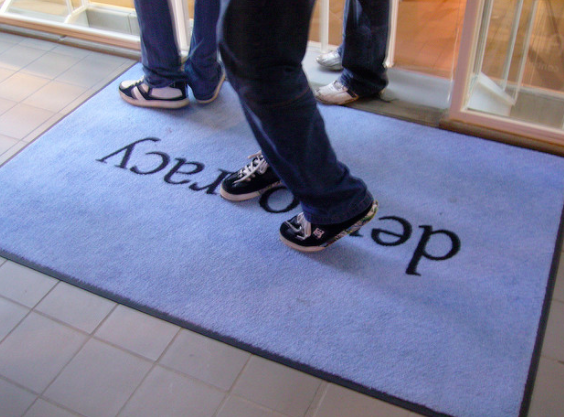
I want to turn your attention to a subject which has been on my mind a lot recently: Freedom and Democracy. Now to some people they are one and the same thing, but I would like to delve a bit deeper, past the superficial.
In the 1970’s, we had a well regulated society in the West and governments which redistributed resources on a fairer basis. It wasn’t perfect but it had ensured practically full employment for two decades prior to that. The NHS and motorways were built, as was mass infrastructure. But somewhere along the line, people endorsed a different approach which they probably didn’t know what they were getting into. Margaret Thatcher and Ronald Reagan were both elected on mandates promoting “Freedom” in every sphere of life: that is, the freedom to choose. When politicians talk about freedom, what they actually mean is “free markets” and a system of economic ideology based around the rise of the individual at the expense of wider society. The freedom to choose is after all dependent on the means and capability to purchase, which not everyone enjoys. This “freedom” meant deregulation of the financial sector, privatisation of publicly owned assets and the gradual destruction of collective bargaining via trade unions. It meant resourcing fascist dictatorships using our taxes, in Chile and in Cambodia. It meant the mass genocide of millions of people by the most authoritarian and brutal regimes the world has ever known, just a few decades after the Holocaust, all in the name of individual gain. It meant the murder of people based on their choice or political circumstances, in the fight between capitalism and communism. I’m not saying communism was ideal or anything, but whatever economic model the people of Vietnam or Cuba live under is a matter for them – let them make their mistakes/successes and let them have their own politics.
The other word I mentioned is “Democracy”. Now democracy can mean many things to many people but put simply it should refer to the collective will of the population. And in that respect, it is not the same as “freedom”, or at least the “freedom” which I referred to. For one, people now realise they don’t want privatisation of public assets. They realise they don’t want war or propping up fascism. They don’t want to live in a society where it’s just “ME, ME, ME; Now, Now, Now; LoadsaMoney!!”
What people do want is full employment, worker’s rights, mass house building, access to education without fees, no hospital waiting lists, more paid vacations and reduced working hours. They want a society where your post-code does not dictate your quality or quantity of life on Earth to any great extent. Is that compatible with “freedom”?
Now, I’m by no means suggesting we should move to some sort of benign dictatorship of the Left. But what I am saying is that in order to move towards what people actually need and not simply what they materially desire in the short-term, the framework of politics has to change. And by that I mean constitutional change. These things have to be guaranteed in law by a real republican constitution which enshrines power in the citizen and grants inalienable rights on Earth; rights which cannot be undermined by future right wing governments ever so keen to take them away for “economic expediency”.
The “most free” countries on Earth are certainly not the most equal, nor do they offer the best quality of life. But the more “democratic” nations do happen to offer the highest standard of living (Norway, Sweden, Finland). The vote means something there, even right down to what food children are served at school or the amount of maternity leave granted.
The point I want to emphasise to you is that when you hear commentators raising the question of whether republicans in Ireland are committed to “freedom”, what they are actually referring to is whether republicans are committed to their interpretation of “freedom” – an economy which is outside the realms of democratic control and accountability. The “freedom” which the Donald Trumps and Margaret Thatchers of this world so vehemently advocate. A rotten and meaningless existence where people know the price of everything and the value of nothing.
I’m of a generation which can still remember when it meant something to get a bike for Christmas and be taught how to use it by one’s elders; Where good manners and asking the older people in the street if they needed anything was worth much more than the latest PlayStation game. That has all been replaced by children spending their lives isolated behind computer screens; by workers afraid to say anything the boss might not favour; by a world where pensioners are ordered to put on extra layers in the midst of icy winter; and by a world where the very soul of man is being consumed by our own consumption. Globalisation hasn’t failed us, it’s killing us. Literally.
I think the time has now come for republicans on this island to have a serious debate about composing a new constitution for Ireland. One which can offer these rights and address these deficiencies. One which is actually based on democracy. This may fall on proverbial deaf ears, but with ever dwindling resources in your own pocket, the only way to guarantee a better world for your children has to be via collective bargaining for the nation as a whole. The defining difference between a future Sinn Fein government in Ireland and one made up of any of the establishment lot has to be the Shakespearean-level distinction between “Freedom” and real Democracy.
Well Said !!! I hope my lifelong support for Sinn Fein justifies your comments
I am confident it will!!!
in the 70s we had a well regulated society……………lolol.
thats not the 70s i remember.
When I last read Bunreacht na hEireann it guaranteed the right to private property, a right subject to the needs of the national community aka “The Common Good.” It seems to me
that answers your requirements.
Norway, Sweden, Denmark and the Netherlands, egalitarian Welfare States, are NOT
Republics, so Republicanism is irrelevant to your argument. Neither is the “United Kingdom”
a Republic, though both you and I cherish the National Health Service and other praiseworthy
institutions there.
The Foundation Stone of the UK Welfare State was the People’s Budget introduced by David
Lloyd George, who, before he prepared it, went over to Berlin to pick the Brains of the Kaiser’s Ministers.Because German social legislation at the time was far in advance of British law.
“It meant resourcing fascist dictatorships using our taxes, in Chile and in Cambodia. It meant the mass genocide of millions of people by the most authoritarian and brutal regimes the world has ever known, just a few decades after the Holocaust, all in the name of individual gain. It meant the murder of people based on their choice or political circumstances, in the fight between capitalism and communism. I’m not saying communism was ideal or anything, but whatever economic model the people of Vietnam or Cuba live under is a matter for them – let them make their mistakes/successes and let them have their own politics.”
This doesn’t make sense. The Vietnam War began in 1965. Yet the blog recognises that the move to neoliberalism occurred in the late 1970s.
There are some generalisations bandied about MT , which can happen when a piece is being hastily written, but you should also remember that although you state in passing that the Vietnam War began in 1965, it had already been running for at least a decade or more ,by then .I don’t think that the USA whose engagement you might be referring to , actually declared war at any time. The French , who were already up to their bootstraps in Vietnam in 1950 , asked the USA for their help in dealing with North Vietnam.