
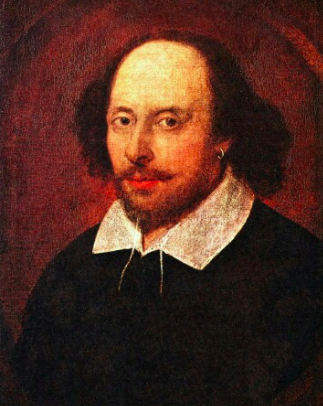
The 400th anniversary of the death of William Shakespeare has rightly been commemorated this year. He is constantly quoted by those who never saw his plays, nor read them nor heard them spoken. He introduced so many new words, into the English language that he is credited with being one of its creators. And his ideas have captured the imagination of many who don’t speak nor read English.
In ways he also invented England, and Eamon de Valera and Churchill collaborated in the production of one of the most powerful pieces of English propaganda during the Second World War when the film Henry V, directed by and starring Laurence Olivier, was shot in neutral Ireland.
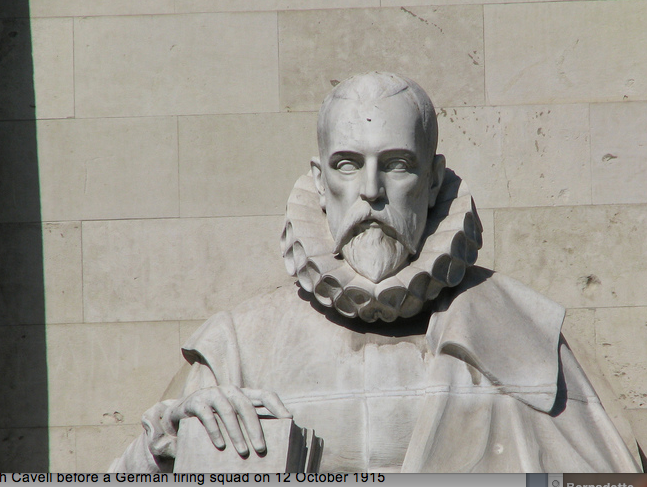
This year is also the 400th year since the death of Miguel Cervantes, who died in April 1616 within a couple of days of Shakespeare. His novel Don Quixote might be a warning about swallowing propaganda. Its protagonist is an old fool with his mind addled with romances, who really should’ve gone to Specsavers. He rides out on a broken-down nag in the guise of a Knight-Errant, to right wrongs, and rescue damsels in distress. He mistakes windmills, very plentiful in Spain, as I have myself witnessed, for predatory and priapic giants. He mistakes whores for innocent virgins, categories whose ratios to each other I would not dare speculate. It’s all good fun, I believe, for the reader, though, alas I have not read the book.
Within months of the death of Edith Cavell before a German firing squad on 12 October 1915 THE TIMES reported that the shooting had been worth “an Army Corps” to the British, as tens of thousands of young men rushed to the British colours, to avenge the atrocity. The Church of England listed Miss Cavell in its Calendar of Saints. Her statue stands in London’s Trafalgar Square beside the National Gallery.
But Edith Cavell was not quite the immaculate innocent painted by British Propaganda. The tens of thousands of young fools who rushed to the British Colours to charge German artillery and machine guns were as blind as the old fool Don Quixote who tilted at windmills believing that he was saving virgins from fates worse than death.
A year ago in October 2015, a full one hundred years after Edith Cavell was shot, Dame Stella Rimmington, former Director of MI 5 revealed that Edith Cavell was not merely a nurse fulfilling a nurse’s humanitarian vocation, but that she was also engaged in activities for British Intelligence, which, according to international rules of war earned the death penalty.
Hi, Jude. I didn’t have to read or learn Shakespeare at school so I was able to come at him fresh, and a couple of years ago, watching a film [by a well-known French director] called ‘J’embrasse pas’ I heard the famous ‘to be or not to be’ speech from Hamlet which led me to investigate further and since then I’ve read all the tragedies and some of the histories, but didn’t bother much with the comedies except the ‘Merchant of Venice’ which apparently was inspired by Marlow’s ‘Jew of Malta’
I’m partly convinced now that Christopher Marlow’s ‘death’ was faked and he went on to write the plays and sonnets credited to the WS from Stratford-on-Avon but fully convinced that even if it wasn’t CM, it couldn’t have been the Shaksper from SoA as he could barely write his own signature and allowed his children to go illiterate. His will makes no mention of manuscripts of any of the 37 plays, or books or any material which could have provided him with source material for the works. Somebody called William Shakespeare undoubtedly wrote the works and possibly someone of that name from Stratford in the East End of London did them. Whoever it was, was a genius.
Hi Daniel – you are a man of knowledge in the area, obviously. One last bit of knowledge for you…the blog is by Donal, not me. Is mor an trua sin – more’s the pity…
I’ take that as read, Jude. Appreciate the compliment. Thx.