
Eddie Whyte was born and brought up in the Bone and Ardoyne. He is an elected national officer in Fagforbundet, Norway’s largest trade union and is active on Palestinian and human rights issues. He recently returned from a fact finding delegation to the Palestinian refugee camps in Lebanon where he met, amongst others, Dublin native Gwyn Lewis who works with the United Nations Relief and Works Agency for Palestine Refugees (UNRWA). She paints a grim picture of life in the camps.
Eddie blogs at https://palestiniansolidarity.wordpress.com/2016/11/22/palestines-forgotten-refugees/
The week after our delegation from Fagforbundet and Norwegian People’s Aid arrived home from Beirut, Lebanon finally got a new President – after a full two years of negotiations. Lebanon is a politically complicated society dependent on a division of power between the three major religious groups – Christians, Sunni and Shia Muslims. The necessary compromises can often take time.
The religious-political situation in the country has its roots in the imperialism of the First World War, the colonial politics of European superpowers and, not least, the relationship to Israeli neighbours further south. There has been a significant presence of Palestinian refugees since 1948 when nearly one million people were forced to flee what the Israeli scholar Ilan Pappé has called the ethnic cleansing of Palestine – the establishment of the state of Israel.

An artist’s portrayal of the forced scattering of Palestinans all over the world
Almost seventy years later in 2016, Lebanon is the country with most refugees per capita in the world. Nearly one-third of a total of six million inhabitants are displaced people or refugees. Over a million of the “new” refugees fled Syria after the war broke out in 2011, and before Lebanon’s Minister of Social Affairs closed the border declaring that the country was on the brink of political and economic collapse.
Among the newly arrived victims of the war are tens of thousands of the half a million Palestinians who have been living in Syria since their families were forced to flee from their original homeland by the Israeli war machine. Having lived in Syria for several generations, many of the Palestinians had become well integrated, gaining some basic economic and social rights but without achieving what would be called full civil or political equality.
Those hard earned rights disappeared when they were forced to cross the border into Lebanon. Lebanon is not Syria. The sectarian division of power is to be maintained at all costs, and citizens rights for Palestinians – who are mainly Sunni Muslim – are seen as a threat to the fragile political status quo.

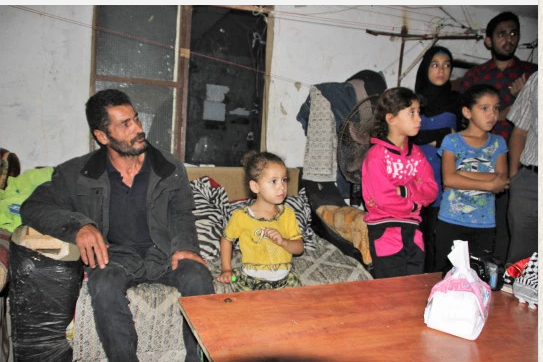
Ibrahim Shawaheen and Family at Rashidieh Camp. Foto: Geirmund Jor
The situation for Palestinian refugees in Lebanon is nothings short of shameful. They have few rights as such and are openly discriminated against, especially in the labor market and housing. They have no automatic access to public schools and health care, have no voting rights, no right to own property, no right to citizenship and are barred from many professions.
Palestinian refugees do not fall under the remit of the UN High Commissioner for Refugees (UNHCR). They “belong” rather to the United Nations Relief and Works Agency (UNRWA) which was created in 1949, one year before the UNHCR. UNRWA was originally intended to be a temporary measure, but now, almost seventy years later, Palestinians are still in the same refugee camps and, even more worrying, totally dependent on the international goodwill of a few nations. UNRWA does not receive regular funding through the United Nations – it is dependent on annual allocations from so-called donor countries, who contribute on a voluntary basis.
The new wave of refugees from the war in Syria has put heavy pressure on Lebanon’s limited public services and has been further exacerbated by the inaction of the world community. A decline in international assistance to Lebanon in 2015 has meant that non-governmental aid agencies have been forced to cut back on relief efforts, whilst UNRWA in particular finds itself in a very difficult situation.

Gwyn Lewis from UNRWA paints a rather grim picture (Photo: Ingunn Eriksen)
Gwyn Lewis is a native of Dublin and a representative for UNRWA in Lebanon. She recently took over the role after several years in Gaza and the West Bank and admits she was shaken by the conditions of Palestinian refugees in Lebanon.
Sitting in her office, behind the security walls of UNWRAs headquarters in Beirut, she is open and honest about concerns for the future. UNRWA faces enormous challenges when it comes to covering Palestinian refugees’ basic needs. She paints a rather grim picture of reality and her emotion and commitment are evident when she says that the organization’s financial crisis is putting refugees lives at risk.
Families are not receiving enough aid to make ends meet and essential services such as health programs, emergency relief, social services and sanitation in the 12 UNRWA camps are about to collapse. The sanitation system in the camps is in a destitute state. The garbage trucks cannot be repaired and yet there are no funds to replace them. The health risk is increasing almost daily.
UNRWA is facing a financial crisis at a time when the area is reeling under the effects of multiple armed conflicts and a massive displacement of people on a scale not seen since the Second World War. The demands now being made on the organization charged by the international community with the welfare and human development of Palestinian refugees have increased dramatically. Indeed, the situation for 5.3 million Palestinian refugees in the Middle East is in many ways worse than at any time since 1948.
The Norwegian government must unfortunately be included among the culprits responsible for this untenable situation. Previously one of UNWRA’s main partners, with a prominent role among donor countries, the situation changed dramatically when Conservatives and the rightwing Progress Party formed a new coalition government in 2013. Since then the Norwegian contribution to humanitarian aid abroad has been reduced dramatically by the same government that prides itself on having Europe’s toughest asylum and immigration laws.
Our current government seems content to accept yet another generation of Palestinians growing up in the horrendous conditions of the cramped refugee camps of Jordan, Syria and Lebanon and Palestine. For those of us who are Norway-based, it gives us yet another incentive to support the campaign for a new government in the national elections due to take place in September next year.
We need political leaders in Norway who will re-establish the policy of international solidarity that until recently has been the hallmark of Norwegian foreign policy. And we need the political leaders in the world community to step up and take responsibility for ensuring a just solution for Palestine and its people. Palestinian refugees have been forgotten for far too long.
Comments are closed.