
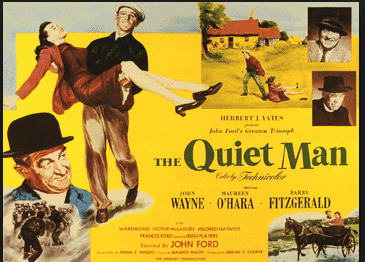
Do you remember The Quiet Man? No, not Iain Duncan-Smith, who tried to make a virtue of having nothing to say when he led the Tory party. I’m talking about the John Wayne/Maureen O’Hara/Barry Fitzgerald/John Ford movie.
We all went to it when it came out in 1952. Even my mother, who usually considered all films dirt and filth, with the exception of The Song of Bernadette. She quite liked The Quiet Man, although she wasn’t so sure about the carry-on that Maureen O’Hara one got up to.
It now emerges that there was more than her a bit iffy regarding the movie. In papers recently released, Ireland’s man in Washington, Joseph D Brennan, wrote to the Department of External Affairs in Ireland: ““The colour is beautiful. The scenery is delightful. But – the theme is not likely to be well received here.”
Earlier this year the Irish-American writer Malachy McCourt expressed his views on the movie : ““Wife-beating, priest-ridden, blather talking gombeen men getting drunk standing around gossiping and then erupting into stereotypical Irish behaviour.”
McCourt is right. John Wayne does a taming-of-the-shrew on flame-haired Maureen O’Hara, the local priest is depicted as a very important man, people gossip and get pie-eyed, and Barry Fitzgerald is the twinkly-eyed leprechaun to beat all leprechauns.
But to condemn the film by today’s standards is a bit stupid. Back then, Irish people didn’t go looking for faults in how they were portrayed in movies: they were just delighted to feature at all. We all laughed our heads off at Barry F’s little side-of-mouth aphorisms and we thrilled when John Wayne slugged it out with the local strong-man.
Would we tolerate a movie like that being made about Ireland today? Almost certainly not. But then we’re sixty-four years from that time. The Quiet Man was of its era. Look at any James Cagney movie around the same period: if a dame slaps Cagney, Cagney usually slaps her back. Black people have subordinate/comic roles if they appear at all, real men settle arguments with their fists and six-shooters on the main street. The Quiet Man mightn’t show us as particularly sophisticated, but look at the movie’s background of beautiful Mayo countryside and the stature of the movie’s stars. Weren’t we lucky to have them.
Loving The Quiet Man is not an acceptance of wife-beating or priest-riding or blather-talking. It’s an acceptance of how the world, and Ireland in particular, was seen at the time. We’d do better to rejoice that we can now see and reject behaviour that then was accepted without question. But to denounce a sixty-four –year-old film for not adhering more closely to today’s politically correct standards is – yup, I’ll say it again – stupid.
love this film and watched it often, now if MMcC really wants to be politically correct the portrayal of the native Americans and what happened to them should give him plenty of food for thought since it is still on-going, the invaders are GOOD (cowboys) and Injuns (Indians) BAD. Who wanted to be an Indian when playing that childhood game of cowboys & injuns. There are definitely a lot more issues I could take offence at in the way the Irish are portrayed to this day.
“Lucky to have” John Wayne? Not so sure about that.
As pointed out the other day, this is my favourite film, we must recall, while Wayne starred in it, it was a John Ford (Feeney) production, and was not so distant from fact, Priests were kings within their Parishes, Bishops, even CoI one’s, were hotlines to God and the critic should remember, Rev. Playfair was a hero of the Easter Rising.
Feck critics, I, my wife, and twenty something childer love the film.
Here’s A Big Stick to beat the Lovely “Malachy McCourt” with.!!
The film is a romantic comedy. It still makes me laugh. Am reminded of Brian Rix Whitehall Farces. No one thought they were a true representation of British life. Leap year, a film starring Amy Adams is a more modern version of the QM. It has some of the same stock characters ,though, they are toned down. The train still features as does the countryside and the laid back people.
At the end of the day (I know, the night) it is a film it’s not reality
The Quiet Man is a masterpiece. Though it’s an obvious retelling of The Taming of the Shrew
I think Shakespeare would have taken his hat off to it. It’s very sexy though NOT sexist. Mary
Kate makes clear she is her own woman and not a mere chattel. Barry Fitzgerald’s “Homeric”
and “Impetuosity” was regarded as too strong for some American censors.
It was not sold as “social realism” nor as didactic propaganda. One of John Ford’s advisors was veteran IRA man and acclaimed writer Ernie O’Malley.Friendship between clergymen of all
denominations was more the rule than the exception in many places.
When the “Parliament of Southern Ireland (unrecognised by Dail Eireann and most Irish voters) met to “ratify the ‘Treaty’ and (appoint an Irregular Junta aka Provisional Govt) more
Irish was spoken than on any one day in Dail Eireann,
Poor Mary Kate was ashamed of refusing her bridegroom his whole entitlement and chose
to confess in Irish, rather than the more widely understood English.
If they show movies in Heaven, The Quiet Man must be the best loved.
The man who has not humour in his soul is fit for treasons, stratagems and spoils.
Compare with John Ford’s version of “The Plough and the Stars” – a real stinker.
After reading your brog today, Esteeemed Blogmeister, one can but quote ‘Red Will’ Danagher (Victor McLaglen):
-You’ll never regret it till the day you die, if you live that long.
Trust the TUT , in the guise of googadawns such as (gulp) Stephen Collins and also, Malachy McCourt, who wears the collar of dollars, , to tut-tut at lines like the following one from Michaleen Flynn (Barry Fitzgerald) :
-Is this a courting or a donnybrook? Have the good manners not to hit the man until he is your husband and your’re entitled to hit you back.
Mention of ‘The Quiet Man’ enables one to seque stealthily in a soft shoe shuffle to a contemporary dramatic work which The Unionist Times has totally not opted to tut-tut at, quite the reverse:
-The Beauty Queen of Leenane.
Here is a random samp of the soggy, damp ‘dialogue’ which swamps this modern masterpiece of, erm, Irish theatre and which is about to girdle the globe in a bid by Biddyland for Global Domination by the Druid Theate which exudes all that is good in the bodily fluid of the Free Southern Stateen:
Mag: I’ll give me Complan another go so, and give it a good stir for meself.
Maureen: Ah, forget your Complan. I’m expected to do everything else. I suppose that
one of top of It won’t hurt. Just a….just a blessed fecking skivvy is all I’m
thought of !
In his pastoral letter designed to give his imprimature to ‘The Beauty Queen of Leenane ’prior to ‘The Complan Chronicle’ spreading its wingspan worldwide, FOT got to mention (gulp) ‘The Quiet Man’: it was only a matter of Times, The Unionist Times, before he did.
Surprisingly, not, the classic John Ford fillum does not come too well out of being mentioned in the same halitosis as ‘The Complan Chronicle’.
-Picture and images of the landscape have replaced the thing itself. Ray Dooley in ‘The Beauty Queen of Leenane’ asks ‘Who wants to see Ireland on telly?’ but the place is crawling with tourists who come looking for where ‘The Quiet Man’ was made but the place is crawling with tourists who come looking for where ‘The Quiet Man’ was made.
Hmmmm.
Does one detect the attitude sniffy to the t for tourist word here or heareabouts? Which is odd, rather, even iffy, considering Archbishop F. O Toole does more than a passable impression, and on a daily basis too, of being a Tourist in a Primitive Territory.
Of course, The Quiet Man is quintessentially 1950’s: to some of us, The Fabulous Fifties but to The Unionist Times and its Broadcasting Wing, RTE, The Scabrous Fifties.
Hong Kong has been targetted by the Druidess of the Druid Theatre as a thespian colony ripe for conquering.
The Quiet Man was fillumed in Cong in 1951 and the Cong Conurbation.
Call The Perkin’s inner Prim Primitive a misogynist but The Quiet Man hockeys The Beauty Queen as a work of art by the proverbial cricket score.
Just take three of the three-bar battle-ground gates in the Fifties Fillum (and was there ever a gait like that of John Wayne ? – The Duke always seemed as if was shimmyying through a patch of rhubarb) :
The chorus: The chorus of shawled and flat-capped peasants in The Quiet Man has come in for some heavy duty cirticism from the snobby cineaste knobs. Whether at the railway staton or at the racing on the strand or to follow the fist fight over hill and down dale this use is invariably denounced as a portrayal of paddywackery at its collective nadir.
Au contraire. Indeed, John Ford’s use in 1951 of the Irish locals as a commentatorry crowd is probably the most inspired use of a chorus in cinematic terms since that other American fillumatic genius, Woody Allen made use of a mock Grecian chorus in his magnificent ‘Mighty Aprhodite’ in 1995.
And just as counterpoint is as vital an ingredient of the cinematic art as the musical one then the decision of the director to set the face of Victor McLaglen in a setting as dreamy as heaven itself was equally inspired. McLaglen’s physog, of course, was reminiscent of the Medieval description:
-‘Ye rugged face like ye olde boiled shyte’.
The song: ‘The Isle of Inisfree’ which Detective Dick Farrelly of Dublin Castle penned on a bus journey from his native Kells to the Busaras is quite simply one of the top three irish songs in the past century: off-ear one thinks of other songs which deserve a spot in that lofty spot: ‘The Lies that you Told me’ by Christie Hennessy and ‘The Dublin Saunter’ by Leo Maguire. Other folks will, of course, have different orders to peck.
Great forward-story about that signature song. It got air time in ET when the eponymous (a daarlin’ word, Joxer) hero is familiarising himself with a remote control in front of a television. And as one channel skips to another channel there is a five-second flash of ‘The Quiet Man’. This was no surprise as the same movie was the favourite fillum of Steven Spielberg as a boy.
What did come as a surprise (rather) was the fat cheque which unexpectedly plopped into the hallway of Chez Farrelly, a year later. It amounted to a mutiple of the moola he had received from ‘The Quiet Man’.
The Leprechaun . Hark to Sir Oracle O’Toole, and let no man bark on ‘The B. Queen of Leenane’:
-Connemara, where the play is is supposed to be a Gaeltacht, an official preserve of native Gaelic speech. But in McDonagh’s Gaelic is just a pale ghost behind the vernacular English of the characters, its dead forms chling on to an en empty afterlife in the baroque syntax of their speech. Where a Gaelic word like ‘gasur’ (boy) intrudes on the dialogue, it serves only to rmind us of an absent, half-forgotten tongue.
Eh?
Gaelic? Back in the Fabulous Fifties in Dublin the only folk who said Gaelic when they meant Irish were English folk and local Protestants. Back in the day when Archbishop Laurence O Toole was in situ in Christchurch, Irish was Irish. Now that Archbishop Fintan O Toole presides in his ‘borrowed’ edifice , Irish has become Gaelic.
Which might explain why Dineen’s Dictionary defines ‘Sasanach’ thus: Engllsh, Protestant.
John Ford was neither of those. A native of Maine, USA he was born John Feeney the son of Seán O Fiannaidhe, an immigrant from An Spidéal, Contae na Gaillimhe. In the early Sixties, The Perkin has pleasant memories of spending a couple of months in Teach Ui Fhiannaidhe, An Spidéal – cousins of John Ford, learning how to lip in the Leprechaun.
It was a house where decorum was poured by the jorum:
-No patty fingers, if you please. The propriieties must be preserved at all time Hold on to your hats!
These were the days when one encountered actors of the Abbey Theatre in the local shop of legend, Teach Standúin. Actors like the superb Pilip O Floinn / Philip O Flynn (was there ever a better Fluther Good, Joxer?). In those dark ages it was considered the (gulp) norm for an Irish actor to be bilingual, even trilingual (including body language).
But that was long ago, in a foreign country and besides the Druidess is still alive.
And in 1991 The Druidess was Artistic Director of the Abbey Theatre/ Amharclann Náisiúnta na hEireann, a year in which another Magnificent Monoglot, Fintan O was, mind, Artistic Adviser.
In later life John Ford had no problem using the original shape of his name. Indeed, there is a exchange of dialogue between Maureen O’Sullivan (as Mary Kate Danagher) and Ward Bond as Fr. Peter Lonergan. Which is mainly in Leprechaun with no apologetic subtitles:
Mary Kate Danagher: Father, could I …..take to you in Irish?
Fr. Peter Longergan (distracted, fishing): Sea, sea.
Mary Kate Danagher; Níor lig mé m’fhear céile isteach im leaba liom aréir. Chuir mé fuinneamh air a chodladh i…o, i mála codlata. Mála codlata !
Fr. Peter Longeran: Céard é sin ? Bag ?
Mary Kate Lonergan: Sleeping bag, Father. With buttons. Níor rith sé ar a shon. An peaca é?
Fr. Peter Lonergan: Woman, Ireland may be a poor country – God help us, but here, a man sleeps in a bad, not a bag !
The Perkin has pleasant memories of once watching ‘The Quiet Man’ under the stars of a West African nightsky in an improvised open air cinema at the European Club (in its dying days) in Upstate Nigeria, circa 1970. After the Irish Embassy (not in Washington) had sent it up by road the 200 miles from Lagos as a St. Patrick’s, oops, Paddy’s Day treat. The audience was one third Irish, one third British and one third, go easy of the splash.
One chap called Wee Charlie from Glasgow ( and who later boxed with Ken Buchanan in prison – don’t ask, it’s complicated) made ‘The Isle of Inisfree’ his party piece.
The Quiet Man has John Ford, sparkles with wit, a light touch, an impish optimism, a technicolour view of life,which is at odds, rather with the dour, witless, grey gloomy and piss-poor pessimism of ‘The Booty Queen of Leeenane’ of the Druidess and Martin MacDona go Leor.
In Leprechaun, this is called ‘dul chun cinn, mar dhea’.
Processed though the German Queen’s English this comes out as:
-Progress, pronounced in certain boggy acres as, prog-ress, mo thoin.
Back then we got The Duke John Wayne, today we get the Duke of Edinburgh on the Wane..
Mine’s a double Jameson.
This in an email from a friend – I thought you should know, Perkin:
“Jude, Just read Perkin’s bit on The Quiet Man, It’s magisterial – he is some pup. What does he do ? He knows everything. I really enjoyed him, especially the Double Jameson. It is a tonic just to read him.”
(Thunderous applause – PW bows in stately fashion…)
Pup is right, cara Jude, a chara.
Unfortunately with Christmas around the corner, God alone knows what the future holds. Or on whose gift list one will end up.
Hopefully, one who believes in a 12-month Season of Good Cheer and the Hard Sell.
Is there some great big ginormous and generous-hearted Amazon.com out there who will always be there for one?
“The Quiet Man ” was/is an enjoyable fantasy of its time .It is no more about the reality of Ireland than “Darby O’Gill and The Little People” is .It has some of the stock”fighting Irish ” stereotypes which actually were loved by the Irish, just as they loved the tough-guy gangsters of Bogart or Jimmy Cagney. Back then film-stars, as opposed to “actors”, always generally played to a type ,or to a character that was their well-known , perceived public -persona. That’s the way people wanted to see them and that is how they wanted to identify with them .
The battle of the sexes is as complicated and as complex as the Shakespearean connotations( “Taming Of The Shrew” ) of Wayne and O’Hara ‘s on-screen portrayal of a relationship. It might not appear politically correct to us some sixty years later , but then again we grew as children playing games like “Japs and Americans” ,” Cowboys and Indians” and reading comics brimming with racial stereotypes. You can figure out who the heroes were supposed to be in those scenarios. A whole toy industry was supported by us children killing the imaginary enemy .In the 1950s and early 1960s there were so many Western series on television with every kind of stereotype .The Native Americans were always deemed a bit slow and cowboys were portrayed as glamorous heroes with a specific Hollywood uniform of tight fitted trousers , neat waistcoats, high-heeled spurred boots and low-slung holstered guns…all topped off with the most stylish stetson hat ….all complete fantasy costumes made by Hollywood costumiers because the reality was a whole lot more grubby and unstylish. Audiences didn’t actually want anything too realistic back in the 1950s. The most popular films for women would have been “weepies” or doomed romances, which any man worth his machismo at all ,would have had to be dragged screaming to watch, by his wife or girlfriend. Even in the early 1960s, when the James Bond movies began ,no-one blinked an eye at the obvious misogny and racism inherent in those stories. Women were objectified and used and the villians were always of some foreign origin.
I can still watch films from ages past and enjoy them immensely for reasons of storytelling , photography and the rest, but i suppose there is now an awareness of background details about the actors’ real selves and a social agenda that is constantly changing too. You’ll always watch a romantic lead like Rock Hudson in a different way when you know that that he really , really could act. There are so many well -made films from the past that are never screened on television because they no longer fit the modern taste. In the film “the Dambusters”, the famous dog has the moniker “Nigger” and in most screenings of the film this has been neatly edited out or censored in some way. Just occasionally the original print is screened.
“Woman of the house,wheres me tae?”
“We all went to it when it came out in 1952. Even my mother, who usually considered all films dirt and filth, with the exception of The Song of Bernadette”
My own mother, not exactly an old lady but she’ll be getting there sooner rather than later, loved The Song of Bernadette and even asked me to buy her it for Christmas around 2-3 years ago. She’s not a big cinema fan, the last movie she ever saw in the cinema was Titanic in 1997. On the other hand, I am a massive movie buff. My brother is an actor and worked with Fifty Shades of Grey star Jamie Dornan (a really nice guy) and X Files star Gillian Anderson (he didn’t like her, no one does, she is renowned for being disliked on film sets). He also did theatre with actress Catherine McCormack, Mel Gibsons wife in the 1995 Scottish blockbuster “Braveheart”. My brother considers her the best actress he ever met, she is very passionate about performances.
My mother’s cousins partner also acted with superstars Daniel Day Lewis and Pete Postlethwaite in “In the Name of the Father”, the story about the British Governments framing of Gerry Conlon and his family. She acted as Gerry’s sister Bridie, not the youngest sister, the sister who we hear is wearing a dog collar.
I have never watched the Quiet Man (I might now though). But Maureen O’Hara was an incredible actress and a brilliant supporter of Ireland. She passed away last October aged in her late 90’s. The year before she was given an Oscar for Life Time achievement, presented to her by Liam Neeson and Clint Eastwood. It was reported in her Will she left money for a fund to help struggling Irish Actors/Actresses and she said she wants her life to be motivation for young Irish people to succeed and follow their dreams. She was very close to John Wayne (the only woman in his circle of close friends, he was very old fashioned apparently) and is said to have been an influence on Wayne converting to Catholicism on his death bed. She was a very fine actress, one of the last of the Golden Age of Hollywood.
“then erupting into stereotypical Irish behaviour”
What exactly is “stereotypical Irish behaviour”? This reminds me of what Oscar winning Irish Actress Brenda Fricker said: “When you are lying drunk at the airport, you’re Irish. When you win an Oscar, you’re British”. The truth is “stereotypical Irish behaviour” is basically anti-Irish sentiment. The media, especially the British media, like to portray the Irish as drunks and wasters. Indeed the British media even go as far as trying to claim successful Irish people as BRITISH. They tried to claim proud Irish man Conor McGregor as British. They did the same with Irish Hollywood star Michael Fassbender. Indeed Fassbender even came out and declared he’s definitely not British and that he’s proud to be Irish. Hollywood star Samuel L Jackson even rebuked a British reporter for trying to claim Irish Actor, Colin Farrell (Jacksons close friend), as British and compared it to a form of slavery. There’s many other cases of this “claiming” of successful Irish people as British.
The reality is this is a form of psychological warfare that is waged by the British media and to a lesser extent other medias. Its not just waged against the Irish but Scottish too. The impression given is you cant be successful if your Irish or Scottish. They want people to associate the word Irish/Scottish with failure, drunks, etc. Scottish Tennis star Andy Murray bashed the media for referring to him as “British” when he wins but “Scottish” when he loses.
As usual, facts is all that matters. The truth is the average English person drinks more alcohol than the average Irish person. According to my sources the crime rate in England is much worse than in Ireland. Education levels in Ireland are better than in England. So its more accurate to portray the average English person as a dumb, uneducated, drunken criminal than the average Irish person…..
But as Henry Kissinger once said: “The truth doesn’t count, its what is perceived to be true that counts”…..
“But to condemn the film by today’s standards is a bit stupid.”
Quite right. It’s a pity many of your contributors don’t understand this. They often seek to apply today’s political standards to events of one hundred years ago and more.
“Quite right. It’s a pity many of your contributors don’t understand this. They often seek to apply today’s political standards to events of one hundred years ago and more”
Yes because films and real life events are comparable…..
& you MT apply the standards of 1690
“& you MT apply the standards of 1690”
Yes: To 1690 I apply the standards of 1690.
Rubbish film
I don’t think Ford’s The Plough and the Stars is a stinker, it is rather strained – as if Ford was a bit in awe of The Theatre. I can understand many people not liking O’Casey’s drama. His style was based on what he knew, a mixture of Abbey naturalism and the over-the-top ‘theatrics’ of the travelling ‘stock’ companies.
They toured Ireland for a century before fizzling out in the 1960s. I imagine the war in the North starting in 1969 didn’t help matters.