
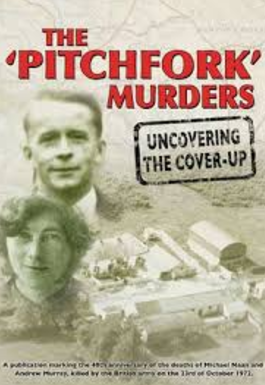
On Monday 23 October 1972, Michael Naan (31) and his neighbour Andrew Murray (24) returned to the Naan farmyard a few miles outside Newtownbutler about 5.00pm on a tractor and trailer after delivering firewood to the Murray house about a mile away in the townland of Derrykenny. It was some time afterwards that they were confronted by a group of British soldiers who had been keeping a watch on the farm for a few days. Within a short time the two farmers were dead – killed by the same British soldiers belonging to the Argyll and Sutherland regiment, a Scottish regiment notorious for their brutality. It was not until about 6.00pm on Tuesday 24thOctober that an oil salesman, John Hanna, who called to see Michael Naan discovered something terribly wrong. He noticed that the lane was blocked by a tractor and trailer with bales of hay on it. He walked around it and then noticed blood on the lane and then a body lying face -up in a swamp at the side of the lane. He was shocked but he immediately drove to the RUC station in Newtownbutler to tell them what he had found. While he waited to see the RUC, he noticed British soldiers in the yard laughing and joking. The RUC followed his car back to the Naan farmyard where they found the two bodies. John also noticed that British soldiers had appeared in the lane and began taking some bales off the trailer to make a kind of sentry post.
Almost immediately, it was rumoured that the killings were mostly likely carried out by men associated with the UDR (Ulster Defence Regiment), in retaliation for the killing of UDR member, Robin Bell, by the IRA a few days earlier. This rumour, we now know, was deliberately circulated by those in the British army press office who were the first to use the term ‘the pitchfork murders’. This term was deliberately used to further the belief that the murders were carried out by local people using pitchforks and acting in retaliation for the UDR man’s murder. This cunning misinformation had the desired effect of diverting attention from the British involvement and pointing the finger at the local UDR which was regarded as a sectarian force. Another rumour was that they killed each other while it was also rumoured to have been carried out by the IRA. The cover-up began immediately and soon these gruesome murders were overshadowed by others that same year. In that year 467 people were killed -39 in the month of October.
It is now clear that the murder of Michael Naan, had been planned by British military intelligence before the killing of the UDR man. The assassination of certain ‘undesirables’ was planned by high-ranking British officers at GHQ as part of ‘Operation Motorman’ which was how Kitson’s strategy for dealing with insurgency was code-named. Michael Naan was singled out based on ‘Intelligence’ gathered in the Lisnaskea-Donagh-Newtownbutler area of Fermanagh by British military police based at St Angelo army base near Enniskillen. They would have known that he was an active member of the Civil Rights movement in Fermanagh. His friend and neighbour, Andrew Murray, was killed to cover the soldiers’ identity. Both men had been stabbed in the heart and chest –Naan 17 times and Murray 13 times.
The truth about the murders of Michael Naan and Andrew Murray would probably never have been discovered but for an unusual occurrence in May 1978, when a member of the Argyll regiment got a guilty conscience after the brutal killing of a prostitute, Helen Rytka, in Yorkshire. She was the ninth woman to be killed in that area. The informant thought these killings were similar in brutality to the killings in Fermanagh in 1972. The informant called the police in Huddersfield and told them that he thought that a member of the Argylls, might be the man responsible for the killing of Helen Rytka. The informant (Mr A) told the police that he thought it was Sergeant Hathaway who was responsible for the Yorkshire killing because some six years earlier he was with him on a tour of duty when he and others killed two farmers in Fermanagh with army issue bayonets. He felt that the man who murdered the women in Yorkshire might be this soldier belonging to the Argyll and Sutherland Highlanders, which was, at that time in 1978, based in Catterick, Yorkshire. (To be continued)
(Historian, Brian McDonald has written a detailed account of this atrocity in a book called The ‘Pitchfork’ Murders –Uncovering the Cover-Up.)
TG4 did a very good documentary on that whole grisly episode recently. End result was that Nationalists said we told you so and the colonists said a load of propaganda and lies. And so life goes on in this sorry little Gibraltar.
War crimes.
You are so right> When will the Dublin government take the Brits to the European court for their war crimes in Ireland?