
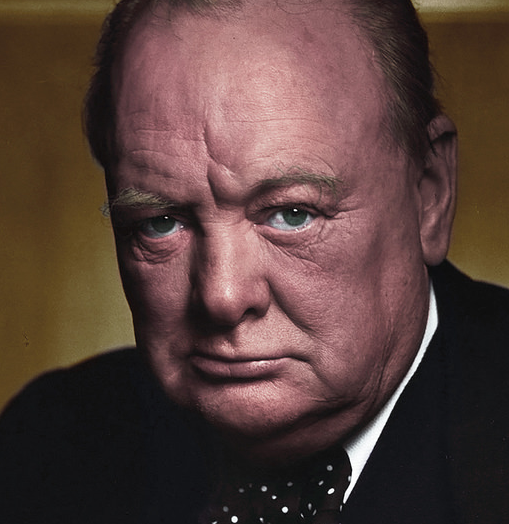
“Winston has written a book about himself” quipped Arthur Balfour, “and called it The World Crisis.”
That. was in 1923 following the first of nine volumes on the Great War which Balfour had been planning since 1904 and in which Churchill played many prominent parts. The 9th volume “The Aftermath” published in 1929, has a sonorous passage, repeated ad nauseam by persons whose critical faculties may be so lulled by Churchill’s rhetorical skills that they consider it profound. Listen again – “Winston has written a book about himself” quipped Arthur Balfour, “and called it The World Crisis.”
“Then came the Great War. Every institution, almost, in the world was strained. Great empires have been overturned. The whole map of Europe has been changed. The modes of thought of men, the whole outlook on affairs, the grouping of parties, all have encountered violent and tremendous changes in the deluge of the world, but as the deluge subsides and the waters fall, we see the dreary steeples of Fermanagh and Tyrone emerging once again. The integrity of the quarrel is one of the few institutions that have been unaltered in the cataclysm which has swept the world.”
I’ve been re-reading “The Soldiers’ Strikes of 1919” written by Andrew Rothstein in 1980. It is very short but packed with information. Rothstein was a soldier in 1919 and had been earmarked for Russia. I’ll quote the blurb on the back. –
“During the turmoil which marked the end of the First World War, an unprecedented wave of strikes and demonstrations took place in the British armed forces over delays in demobilisation. I
Although they were not revolutionary mutinies, their effect was almost as dramatic. Government plans for a leisurely demobilisation were reversed and millions of men returned to civilian life. Their determined action also imposed a profound change in foreign policy. As the troops became aware from the press of Britain’s intention to launch a large scale intervention against the young Soviet Republic, their protests forced the Government to drop its plans, much to the indignation of Winston Churchill and his friends.”
Churchill had been made Minister for War early in January 1919 merely two months after the Armistice and was planning to employ GERMAN TROOPS as his allies in an Anti-Soviet Crusade.
Twenty-six years later, according to Michael Portillo, the “visionary” Churchill, following the Red Army’s capture of the Reichstag, Churchill was planning to attack his Russian Allies and co-opt the defeated forces of the Third Reich for an all-out attack on a devastated Russia.
The Labour victory in Britain’s General Election put paid to his nefarious little plans. Integrity had nothing to do with Churchill’s quarrels nor his delusions.
He was back in office as Prime Minister from 1951 to 1955. Voters in Fermanagh and Tyrone will remember how in 1955 the Unionist loser, Colonel Grosvenor, was awarded the Parliamentary seat which a majority of voters wished kept empty when they chose a Republican prisoner to represent then in absentia (et in vinculis!).
And the point of this article is?
Ah you must be new around here? Perhaps ‘the point’ is war criminal Churchill wasn’t truly on the side of the red army after all? It would certainly explain why the red army viewed the allies with deep suspicion after ww2 and hence the Cold War?
suspicion between communists and capitalists??? I think you are onto something Wolfie! You should tell people.
Nope Joe b, please pay attention, suspicious of those who were opposed to the Nazis(red army most definitely) and those perhaps whom pretended they were against the Nazis I.e the Britishers. After all it wouldn’t be unlike the Britishers to stand back and let the two sides(Nazis and red army) cut each other’s throats and wait to see which side triumphs, would it now? And if you witness the haste in which the so called allies moved once they realised the red army seemed to making progress you’d be forgiven for thinking they certainly didn’t want the red army to succeed? But thanks for your input anyway, as always you are blast.
More like the rest of the world is suspicious of the Britishers.