
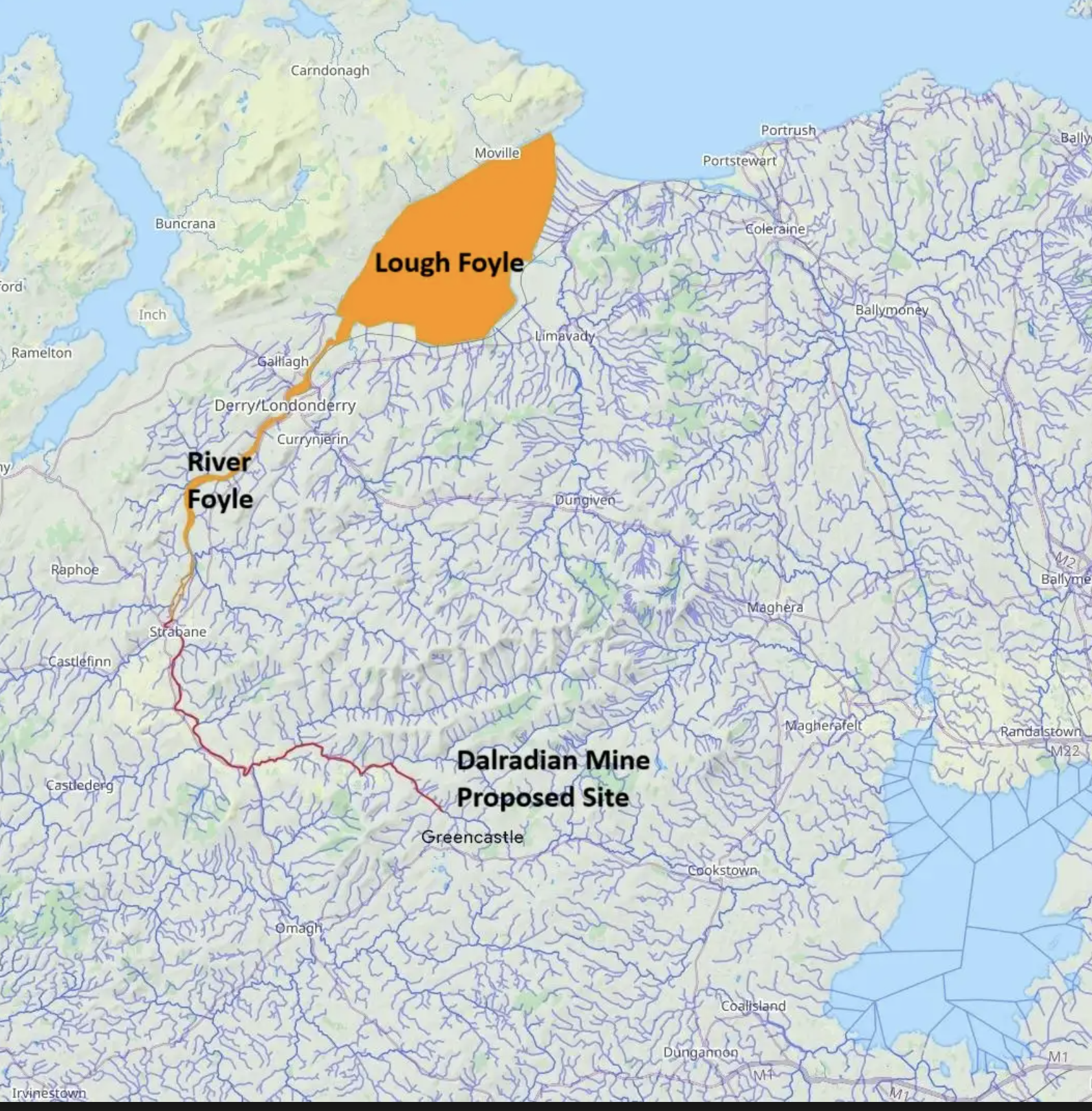
 Map showing the watercourse from the proposed site of the Dalradian gold mine in County Tyrone which flows into the River Foyle, Lough Foyle and into the Atlantic.
Citizen rights under international environmental treaty hampered by lack of ‘precise, legally defined, mutually agreed international boundary’ between the North and the Republic of Ireland
An apparently minor omission by the North’s Department for Infrastructure regarding Dalradian’s proposed goldmine project in County Tyrone’s Sperrin Mountains could trigger a constitutional crisis.
That is the view of seasoned environmental activist, Enda Craig, chairperson of Donegal’s Community for a Clean Estuary (CFCE) campaign.
He explained: “There is no precise, legally defined, mutually agreed international boundary between the Republic of Ireland and the North.
“Essentially, this means people living in Donegal may be excluded from the ongoing Transboundary Public Consultation (TPC) on Dalradian’s proposed gold mine.
“They will therefore be unable to express their concerns, primarily that cyanide used in the gold mining process will enter the River Foyle and Lough Foyle,” said Mr Craig.
The legal requirement for a TPC abruptly halted the Planning Appeals Commission public inquiry into the proposed goldmine at Curraghinalt near Greencastle, on January 13 – two days after it opened in the Strule Arts Centre in Omagh.
Inquiry chairperson, Jacqueline McParland, was informed the Department of Infrastructure, headed by then Minister John O’Dowd (Sinn Féin), had failed to consult the relevant Irish authorities on the transboundary implications of the proposal.
Responding to a question from Labour party leader, Ivana Bacik TD, in Dáil Éireann on February 11, Minister for Housing, Local Government and Heritage, James Browne, confirmed the statutory responsibility for transboundary consultation was enshrined in the Convention on Environmental Impact Assessment in a Transboundary Context – the Espoo Convention for short – to which Ireland and Britain are both signatories.
[https://www.oireachtas.ie/en/debates/question/2025-02-11/361/]
Espoo is a United Nations Economic Commission for Europe treaty legally obliging signatories to assess the environmental impact of certain activities at an early stage of planning, and to notify and consult each other on projects likely to have a significant adverse transboundary impact.
Subsequently notified by the Department of Infrastructure, the Dublin Government began a TPC on Dalradian’s proposed goldmine project. Led by Donegal County Council, the TCP opened on February 26 and closes on April 23; anyone in Ireland can make a submission.
Mr Craig, who keeps a weather eye on any developments which might have a detrimental impact on the Foyle, set about compiling a submission on behalf of CFCE, based in Moville on the Lough Foyle shore of the Inishowen peninsula.
“That was when, unbelievably, I discovered no international boundary exists between the two regions!” he said.
“I know because I consulted the official map where it can be seen there is no international boundary line whatsoever in relation to any part of Lough Foyle – especially between Muff and Greencastle on the County Donegal coastline. The boundary indicator stops at Muff,” added Mr Craig.
“To enable CFCE to prepare a thorough and accurate submission, I have therefore sought clarification on the location of the international boundary in relation to the River Foyle and the identification of the lawful owners of its riverbed, soil and waters, from Donegal County Council – TPC lead. To date this has not been forthcoming.
“Clarity on the international boundary is vitally important in the case of Dalradian’s gold mine application. Without a clear agreement on the boundary, citizens of the Irish Republic cannot effectively invoke their rights under the Espoo Convention.
“CFCE is therefore urging the Irish Government and Donegal County Council to step in and halt proceedings until this crucial matter is addressed.
“As such, until this boundary issue is resolved, the Department for Infrastructure is required to place Dalradian’s planning application on hold.”
Both governments have long danced around the question of ownership, each staking their claim, yet over the course of more than a century, neither has pursued their claim through legal channels.
The responsibility lies squarely with the governments to establish a legally recognized boundary. Only then can citizens of the Republic of Ireland submit a valid case under the Espoo Convention.
Ultimately, the onus is on them to address this unresolved issue. It remains an important technicality… but one that cannot be overlooked.