
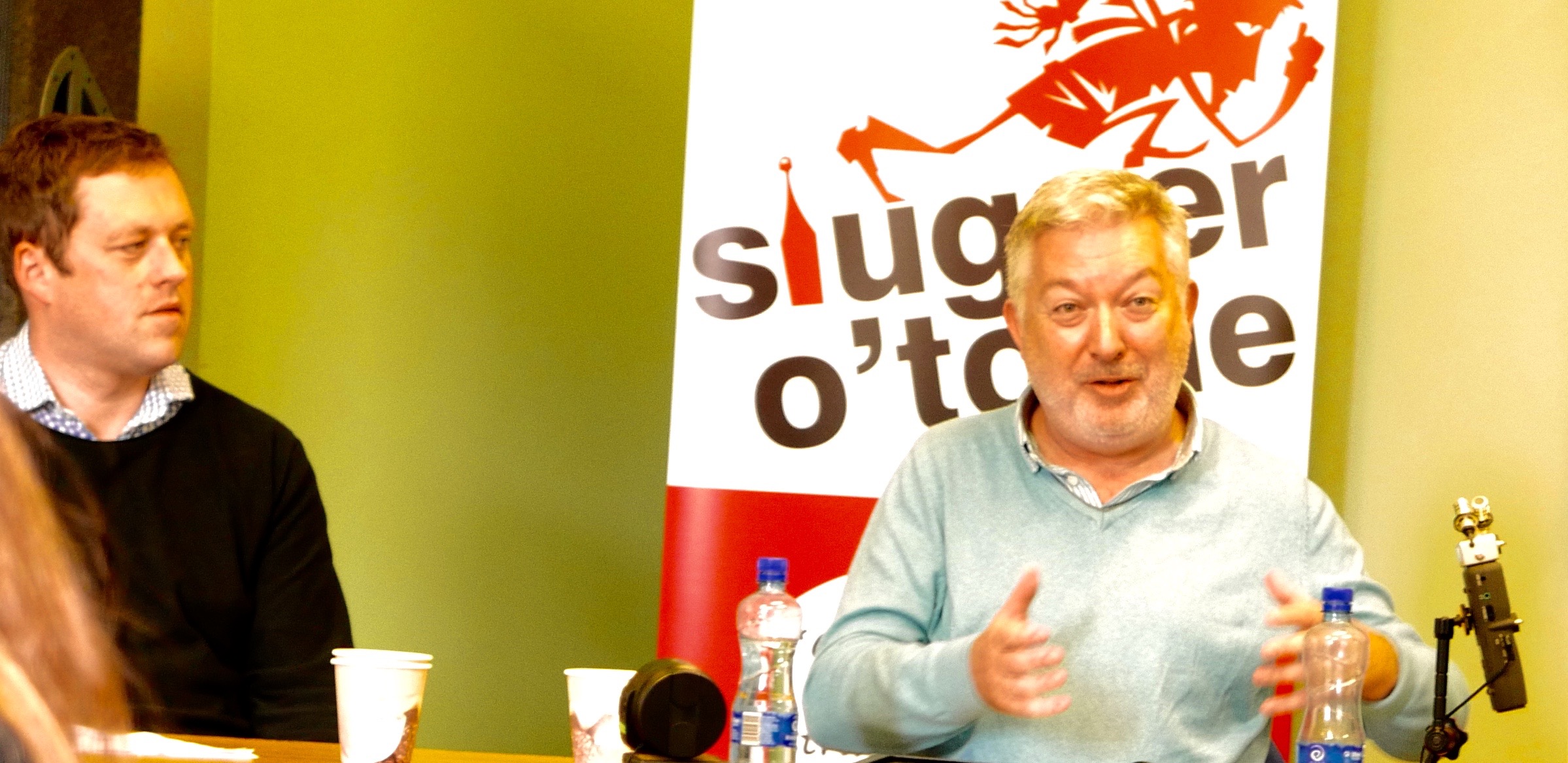
Every so often I run into a situation that seems to contradict itself. For example, I was at a political discussion about the implications of a united Ireland yesterday in Killough, Co. Down. It was clear that the people there were fascinated by the different perspectives on the notion of a UI – there were more people talking or wanting to talk than there was time for them to be heard. The Lighthouse Festival, as it’s been christened, started with a fascination presentation by Chris Donnelly, who gave some facts and figures of voting patterns here since the early 1990s. One key point he made: fewer and fewer people are voting. And it’s true. Yet here you had a group of people from varying backgrounds who were hungry for information and exchange of ideas. Do you understand that? I don’t.
Chris’s excellent (and factual) presentation set the scene for comments from panel members. There was a Fianna Fail senator, a Sinn Féin senator, and Tom Kelly, a former vice-president (I think) with the SDLP, now a columnist with the VO.
Tom is an obviously intelligent and articulate man, and some of the things he said were very interesting. I thought he had said that the SDLP regarded nationalism as an outmoded nineteenth-century concept; Tom corrected me and said (I think) that he wasn’t saying the SDLP held to this view on nationalism – he did. There was then some wandering round the houses by the Fianna Fail senator on what is a nation anyway? I find this kind of talk a little irritating. Not because there isn’t room for scrutinising what we think of as a nation but because what we mean by a nation in Irish terms is patently obvious: read the Easter Proclamation and it’s all there. The fact that we’re a much more culturally diverse country now than a hundred years ago doesn’t change a thing: all the children of the nation remain equally deserving of protection and support. So maybe it’d be better if we didn’t complicate what isn’t particularly complicated.
A point I raised from the floor but which I don’t think was fully addressed was on the economics of a united Ireland. Tom Kelly saw no need for discussion here: we in the north received a massive subvention from Britain and that’s that. Well actually no it’s not. Because there are quite a few people – inside and outside of Sinn Féin – who believe the figures on the British subvention are very shaky when closely examined. But of course even if Sinn Féin were to produce verified figures which showed that the British subvention was much less than is claimed, they’d be dismissed: they would say that, wouldn’t they? What’s needed – and the sooner the better -is a set of figures produced by an agreed, independent finance/accountancy organisation, showing exactly how much in fact we receive from Britain and how much we feed back to Britain in the form of taxes. And while they’re at it, they might want to look at the claimed savings were duplication of services – health, education, infrastructure – to be abandoned and replaced by all-Ireland provision.
There was one fascinating incidental insight: a man who had worked with the SNP in the lead-up to the Scottish referendum was absolutely convinced that Scotland, in the near rather than the distant future, will leave the Union.
A compelling day of discussion, and all credit to those who organised it and to Slugger O’Toole for sponsoring it. But I’m still baffled as to why numbers making their way to the polling booths are declining.
All answers inside 100 words, please…
Jude, agree that Chris Donnelly’s presentation was excellent and the debate afterwards was fascinating – some great contributions.
In relation to voter apathy, I dont necessarily agree with the notion “the electoate arent engaged” that many people use. I know a lot of people who are politically engaged but dont vote! I feel the electorate arent being engaged by the nationalist political parties, thus creating an apathetic feeling. Tom made a few good points on this when he said there was nothing to motivate Nationalist voters, as there had been previously (GFA) and that Nationalism was “running out of steam.” Scotland is a prime example of how voters can be engaged with 84.5% turnout – would a border poll, thus do the same, create a buzz and momemtum, driving people to the polls? Or, are there more simplistic answers?
Within Nationalism, there are two main parties – do they represent the view of all Nationalists? Unionism have a far greater choice, representing the diverse strands of Unionism! Within Nationalism, is the lack of choice resulting in apathy? The practising Catholic – who represents them now particularly as Nationalist parties have articulted their views on abortion, same sex marriage et al? The SDLP are a party in decline (regardless of what Tom says). They lack any cutting edge, Charisma or leadership – not appealing at all! Switched off SDLP voters arent ideally going to vote SF – particularly when they equate the argument of past violence (and other issues) to the SF leadership and vice versa. SF on the other hand, and their links to the past will always alienate voters – Between the two Nationalist parties we see a lack of co-operation – Unionism overcame this, this year in the General Election with the Unionist pact, thus eating into Nationalist constituencies – would a coherent Nationalist pact entice voters onto the streets? Unionism motivates their electorate by “fear” and have successfully done so since its inception – Nationalism needs to engage their elecorate with aspiration – by providing a driving force and progressive mentality to get voters to the polls!
Do the Nationalist parties need to be out on the streets engaging with the electorate, asking why people arent voting and addressing these issues? Its not enough visiting doors just around election time – how can people take politicans seriously when they are simply visiting wanting their vote – thats it! And not seen again until the next election! More regular visits and engagement might instil confidence in politicans and encourage people to vote!
I feel however, a blueprint is required for a new Ireland – we can talk all day about what a New Ireland looks like, but to have a blueprint to reference would be a massive benefit to any argument.
Very good, The Hist – I think there’s a lot in what you say. But the decline in voting numbers is affecting all sides, not just nationalists +republicans. I have a feeling that 2016 could be a significant year as people look at what has been achieve and what remains to be achieved – and I’m not talking solely about partition. And as Macmillan said ‘Events, dear boy, events’ – who knows what could jump up inside the next twelve months even? But I think sessions like yesterday are very helpful in stimulating people’s interest. AFter that, the next logical thing is to do something about what you see as the problem. That has to have some link with the voting booth – as you say, maybe politicians need to listen a bit more to people’s concerns. However, leadership and a vision are very very important factors as well.
Totally agree with you, Jude – the “where to next” is the important element of these debates – and more of them can only start adding drive and energy to the whole discussion. SF and other parties serious about a New Ireland must build common links with the SNP and use their campaign structure et al as a platform, tailoring to the needs of this place, to get the ball rolling …
After the 2016 commemorations we enter a period whereby political process totally altered this country 100 years ago, coupled with the centenary of the extension of voting franchise to women – could this open the debate and challenge voter apathy? A period of voter / non voter reflection? Who knows – but, as voter apathy increases, political parties must be willing to challenge why and act on it!
I read this academic analysis of voter apathy in the North there and think it might interest you – from 2014, I believe:
https://whereareyoufrancishutcheson.wordpress.com/2014/01/26/mind-the-gap/
Well said Hist, I agree 100% particularly on what you said about lack of nationalist co-operation. The SDLP are to blame for this because Sinn Fein has approached them warning of the consequences of a Unionist pact if Nationalism didn’t do one of their own. The SDLP ignored this but they wont be able to ignore it next time when they are on the verge of losing their South Belfast seat. Then again one could argue that SF wanted “3 for 1” as an SDLP member put it when SF put its proposal forward for a Nationalist pact. Maybe SF could’ve made the offer of a pact more lucrative for the SDLP?
Unionism lives on fear and practices blunt sectarian politics. If Martin McGuinness is ever on a serious verge of becoming the official First Minister (and he will, sooner or later) then I wouldn’t be surprised if the DUP/UUP resorted to merging as one party in order to stop it. The fear of “them’uns” and the politics of “Keep them’uns out” will drive them to desperate measures. My own opinion on Unionism is that they are their own worst enemies, leave them to their own devices.
The SDLP and Sinn Fein needs to put aside petty party differences and learn to co-operate and work together for the benefit of all Nationalists. The General Election in May shows what happens when they don’t and what potential gains Nationalists have missed out on for another 5 years…..
Matin McGuinness is already technically First Minister. There is no practical difference between the first and deputy first minister, they are both part of the office of First minister. I don’t think SDLP will come to the party. They handed the DUP the seat in F. South Tyrone. If they keep going the way they are they won’t exist in 10 years anyway.
I agree with you Ryan and Emmet – With FF planning to contest elections in the North from 2019, this could potentially eat into the SDLP vote however big or small. Although I do believe, for survival purposes the SDLP need to act soon, as election results have consistently illustrated their decline – In my opinion, they are a dying party, little life left in them – they should be looking for opportunities to breathe new life into them – as the party does not have that from within – I believe the SDLP need to think seriously about a pact with SF to even safeguard constituencies where they still have a core vote – but then again what damage would this do to SF or SDLP voters who are against such a pact?
As you say, failure to agree on FST allowed Unionism to take the seat – Local PR (STV) elections – The failure of both parties to endorse the transferring of vote between one another has only served to damage both parties – Has the priority of both SF and SDLP been to electorally outmanoeuvre one another, whilst at the same time, damaging nationalism and create voter apathy / disengage the Nationalist electorate? Political Unionism illustrated in the 2015 GE their ability to merge (differences put aside) and the positive benefits that emanate! I can only assume this is not the end of Unionist pacts but merely the beginning … Nationalism needs to think long and hard as to how they counteract this … and respond! Quickly!
Mr Spock might have said, “It is not logical.”
There is a homelessness crisis, however, a recent poll indicates a continuing decline in support for the Irish Labour Party.
An Taoiseach has said the homelessness crisis is not a question of a lack of resources or money.
Mr Kenny said ” It is not a question of money, it is not a question of lack of resources. It is a case of having joined-up thinking, common sense and a response to emergencies as they arise.”
Now we know.
The right wing of Fianna Fáil are keen to enter into a pact with Fine Gael. Its left wing (?) wish to do business with Sinn Féin. The poll has given rise to speculation about the demise of civil war politics. Perhaps findings in relation to the Green Party are more indicative of the fact that potential voters are not as green as they used to be when it comes to a mania for mercs.
Well,Iolar, I suppose we gotta have a dream. But when, as the ever eagle-eyed Perkin points out, Simon the Rattle writes a Sindo article headed ‘Are we ready for the terrorist Gerry Adams to be in the Cabinet?’ it’s hard not to assume that he either believes there are a lot of people out there that share his thinking or that his eloquence will persuade a considerable number to think like him.
Jude ,you forgot to mention that Tom Kelly was awarded the OBE for “services rendered”.Nuff said!
One’s flabber was relatively gasted, Esteemed Blogmeister, to see a F.Failiure sharing a platform with a Shinner. In the same week the party of Dev was declining to sup with the devils even with the long spoon inherited from the Long Fellow.
Till on mature reflection one remembered that that’s what lighthouses were designed for: to cope with the hazardous reefs of Republicanism and that sort of thingy. Either that or seven days is a long spoon in politics.
As to why the numbers bound for the polling booths are declining this can be explained in under 100 words down here in the Free Southern Stateen. Actually in two: Simon Harris.
As one quick gawk at the intersquawk he gives to the Fineday Independent today will reveal: ‘Are we ready for the terrorist Gerry Adams to be in the cabinet? Are we? I don’t believe we are’.
Simon Harris fills the vacancy (in every sense of the v-word) left by the departure of Brian ‘Maze’ Hayes for Europe: his junior altar-boy looks guaranteed that. The seaside town in County Wicklow for which he is a representative gives a hint of the hidden maturity which nestles beneath his beardless exterior: Greystones.
And not for nothing is his nickname in the ranks of the Redmondites: Rattle. When the bars of the terrs’ cages need to be rattled, Simon is your only boy.
Simon the Rattle is nothing if not versatile: not only does he fill the sneakers of Hayes the Maze with aplomb but the outsized flip flops of the departing Pat Rabbitte.fit his feet quite snugly too. The latter may be explained by a common ancestry of sorts.
Both sprang from the Teach Laighean’s of one, Joel Chandler Harris. He was the original Greystones, and Father of the House: with the right one he gave us Simon and with the left one, Brer Rabbit. This is all one needs to know as to how the Blue Shirts and the Red Flags have always managed to coalesce so seamlessly in the surrounds of Leinster House. The minor partners need but put the Red into Redmondite.
Simon likes nothing better than to give the rhymes of the original Greystones a good ratlle, not least when the wondrous recovery of the FSS’s flat-bottomed economy due to the Red and Blue Duet,need to be serenaded, which is roughly every fifty minutes or so:
‘When de Sun helt its own up in de sky
An’ de long drouth come, and de branch run dry,
Mr. Fox and’ Mr. Wolf look like dey’d die;
An’ all de creeturs wuz in de same fix,
Ceppin’ ol’ Brer Rabbit, wid his errytating tricks’.
To conclude: on even more mature reflection, such as – Simon the Rattle might even have the opposite effect – and propel the formerly apathetic to the polling booths with the following slogan on their laptops: Anyone but Him !
Ni mor dom iarracht nios fearr a dheanamh / Must try harder.
Why are fewer and fewer people voting here? Its rather simple: because people here are sick to the back teeth with their politicians. Most people prefer Stormont over Westminster rule but that’s mostly due to economic reasons: no water charges, no prescription charges, the cuts here will not be as bad as in England, etc. And not to mention if Stormont were to collapse and Westminster took over, that would leave a vacuum for extremists from both communities to exploit.
Fewer people vote here because they don’t believe their politicians are worth the effort of getting up and going to the voting booth. The “They’re all the same” or “They’re all in it for themselves” mentality is getting stronger here.
I’ve noticed that there’s a growing perception amongst some Nationalists that Sinn Fein aren’t doing enough to combat sectarian Orange/Loyalist parades, particularly the one going by St Patricks Chapel, all the while Nationalists in Derry are showing tolerance to Loyalist parades, this is getting no or very little appreciation or thanks from Unionism. In fact Unionism is getting more hostile towards Irishness rather than less. To put it bluntly, some Nationalists view Sinn Feins attitude to Unionism as arse kissing. That’s not how I view it btw but that’s how its viewed by a lot and this is putting a lot of nationalists/republicans off voting. Believe it or not I actually came across a republican on twitter who voted for Tom Elliot at the General Election because of Martin McGuinness going to a banquet for Queen Elizabeth. It was a “Protest Vote” apparently.
I believe all these factors are causing some of the electorate, amongst Nationalists anyway, not to bother coming out to vote. The Nationalist parties, SF in particular, have to do something about it quickly.
if voting changed anything it would banned,thats an oul but true saying..people have tippled to the gravy train of the gfa,as for all children treated equal protection ect..there was 1 had his hands nailed to a worktop the other day and hardly a word about it,some of the ones doing the nailing are members of parties looking you to vote for them,like turkeys voting for xmas.
billy
That is interesting. Who were they?
some usually go under the guise of wait for it,community workers lol,you see them round bonfires or driving about in 30grand jeeps paid for by selling hankies they drew in long kesh,you know the type,
Quite simple, Jude: people like politics but they don’t like the politicians we have.
And you might counter: then why are they voted in?
And the answer is: what are the rejects like? Uselesser!
There is one apparently decent, relatively honest man in Westminster, Jeremy Corbyn, and you can understand opposition parties criticising him for allowing his name to go forward for leadership of the Labour Party.
But I am amazed at the vitriol from his own party members, his fellow candidates, and especially from the has-beens Blair and Brown who have taken time out from their lucrative retirements to paint him as the political devil incarnate.
They are intending, if Jeremy wins the leadership vote, to sabotage the party’s chances in the next election, and possibly the following one, just because they are afraid of someone of principle leading the party.
Given that your blogs recently dealt with the economics of an United Ireland,you might have been better placed as a panellist rather than being in the body of the hall.I’m not aware from your blog how useful or persuasive was the contribution from the Sinn Fein representative .
You could well be right, Argenta – but if you’re not asked to dance you should remain seated…The SF contribution was quite interesting – as was the Fianna Fail one. But there’s only so much I can get (or find time for ) in one blog, so I concentrated on Tom Kelly. Hope that’s Ok with you…
Here is your chance Jude tell me why my future would be better in a united Ireland?
I can’t tell you why you should want a united Ireland. I know why I want one: because when you become an adult, you should act like one and run your own affairs, not have the man next door, however nice he be, do it for you.Sin é.
That’s weak Jude very weak and that’s why nationalists and republicans are caught in a bind.
Well if you tell me how it’s weak, neill, that’d be more constructive, don’t you think?
Therein lies the problem Jude. Our politicians are not adults. They are not capable of acting responsibly and taking the hard economic decisions that Governments have to. They talk of flags, contentious parades, the past, gay cakes – anything but what they should be talking about – jobs, prosperity, hope. I would personally rather be run from Westminster (I accept that many would rather it were Dublin and even that would be better) than have this bunch that we have here, dictate my future – they are simply not up to it.
There are two figures that I came across recently that shocked me. €55 and €15. These are the respective office rents per square foot in Dublin and Belfast. All you need to know right there.
In a united Ireland you would be able to run your own affairs?
Really so do they decide their economic policy set your own interest rates? oh hang on the Germans do that for the South
So much for running your own affairs Jude!
Um, I didn’t say I’m in favour of a united Ireland that is the present southern state in bloated-by-six-counties form. I’d just like to be part of running our own affairs like, say, oh, who…England, maybe?
Jude
That could just as easily be an argument for devolving further powers to Stormont, so hardly sufficient reason in itself?