
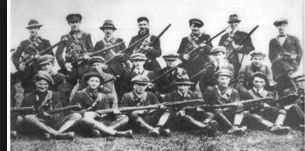
Readers of the Sunday Independent will no doubt be familiar with the relentless spreading of anti-nationalist/anti-republican bile spearheaded by columnist Eoghan Harris, in particular his almost weekly assault on those who fought against British occupying forces during the Irish War of Independence of 1919-1921, claiming republicans were motivated by sectarianism and engaged in the ethnic cleansing and the extermination of Protestants in west Cork. This period in Irish history was one of turmoil and disorder in which the legitimate authority of the State, brought about by the1918 general election when Sinn Fein received a massive electoral endorsement winning 75 of the 103 seats and which was endorsed by the first Dáil Éireann in January 1919, was rejected by the British government. It is regrettable that some columnists writing in the Sunday Independent, and other publications, regularly portray, falsely, the struggle for freedom from colonial oppression during the War of Independence as generalised anti-Protestant sectarianism. It is also regrettable that Independent newspapers has allowed a partisan figure like Harris to dictate understanding of this period of Irish history almost uncontested as alternative viewpoints differing from those of Mr Harris are mainly ignored. Eoghan Harris regularly raises the alleged sectarian killing of ten Protestant civilians in the Bandon Valley in Cork in April 1922. The reason for these killings is a matter of contested debate. Did republicans fight a sectarian war or a political war during the War of Independence? If we are to accept the view of southern Protestants then it was a non-sectarian campaign. After the April 1922 killings, a Protestant Convention, fully representative of southern Protestantism, met in the Mansion House. On 11 May 1922 they resolved, ‘that until the recent tragedies in the County Cork, hostility to Protestants by reason of their religion, has been almost if not wholly, unknown in the twenty six counties in which Protestants are in a minority.’ Furthermore, the killings of these 10 Protestant civilians was acknowledged by leading Methodist Crown Prosecutor and west Cork independent TD Jasper Wolfe (who coordinated loyalist compensation claims) as non-sectarian. In other words, Protestants regarded these killings as exceptional. Trading on and promoting society’s capacity for self-doubt and introspection, Mr Harris generates a propaganda diet reminiscent of that promoted by Carson and Craig. They drove thousands of Catholics out of jobs and houses in 1920-22. Brave Protestant socialists who opposed this unionist sectarian drive to divide the working class in the six counties were also driven out.
Present day Protestants who oppose Harris’s views on the War of Independence are also subject to ad hominem attack. Dr Martin Mansergh, who served under three Fianna Fáil leaders as Director of Research, Policy and Special Advisor on Northern Ireland, was a target of Eoghan Harris on this very issue. Writing on October 9th in 2005 on the killing of the Protestant Pearson brothers in Coolacrease, Harris had the effrontery to term then Senator Mansergh a “posh southern Protestant” who “provides a rotten role model for any young Protestant Irishman”. Harris was equally offensive the following week: “Dr Martin Mansergh…. has a posh accent. I could almost hear his dulcet tones in his Irish Times column last week”. Eoghan Harris’s narrow-minded sectarian vision of Irish identity, the one promoted almost weekly in the Sunday Independent, is contrasted by the broadminded response from southern Protestants in Irish civil society during 1920-22. They said exactly the same as their co-religionist of today, Dr Mansergh, that Republicans were non sectarian in the War of Independence. Indeed, one of the reasons we had a War of Independence in the first place, was in reaction to the sectarian nature of British rule.
It is regrettable that Eoghan Harris is given almost unchallenged column inches to promote partisan politics in defiance of objectivity and fairness. It is also unfortunate that narrow-minded sectarian propaganda is published uncritically by the Sunday Independent, ironically in the name of balance and fairness. It is unworthy of a newspaper of supposed record to relentlessly permit allegations that Roman Catholics felt such hatred for their Protestant neighbours, purely on the basis of religious belief, that they harassed, persecuted and even murdered them generally in a sectarian manner. These allegations by Harris, almost on a weekly basis in the Sunday Independent, that the primary motivation behind the killings of Protestants during the War of Independence was sectarian, is itself sectarian.
Also during this period of the War of Independence another contentious claim of sectarian killings of Protestants emerged which was referred to as the “Coolacrease killings” in Co Offaly. Two brothers named Pearson were killed by the IRA in June 1921. This was acknowledged by the IRA. Following these killings Fr Montgomery Hitchock, a historian and Rector of nearby Kinnitty, stated that the area was ‘absolutely free from sectarian feeling, not to say bitterness’. He had ‘never known one case of religious intolerance. We can only live and let live down here’. How could a Church of Ireland clergyman square the killing of the Pearsons (who were not “pacifists”) with this statement? It can only be that during the course of the conflict, when a member of a minority religious community was attacked, it was generally perceived as being due to activity not religious identity. However, having been in search of a suitable ‘atrocity’ perpetrated by republicans against innocent Protestants during the period of the War of Independence, Ireland’s political revisionists appear to have settled on the killings of the Pearson brothers as their cause célébre. Claims that the exposure of the killings at Coolacrease has made an important contribution to debunking the ‘sordid lie’ of the War of Independence, clearly implies that these killings were either sectarian in nature or a land grab by the IRA. However, events and words in Offaly at that time suggests otherwise.
The Pearson family were very much part of the local community and were held in high esteem by their neighbours. Indeed, the father William Pearson was so well regarded as to be elected an officer of the Kings County Farmers Association in Kinnity. In June 1921 the Cadamstown, Co Offaly, unit of the IRA was ordered to block the Birr-Tullamore road in anticipation of a British army convoy traveling this route. At around midnight the roadblock party came under gun attack with three IRA casualties. Following an investigation by officers of the local IRA leadership, the identities of the attackers was established as the three Pearson brothers of Coolacrease. The Pearson farmhouse was kept under observation and their mail was intercepted. It was noted that British staff army officers were regular visitors to the farmhouse. Having satisfied themselves that not alone were the Pearsons responsible for the armed attack on members of the IRA, but were also passing information on republicans to the British army, Thomas Burke, Officer in Command No 2 Brigade Offaly IRA ordered that the three brothers be executed and their house burnt. This order was carried out on June 30th 1921 and both Richard and Abraham Pearson were executed as British spies. The Pearson brothers had deliberately and consciously engaged in an act of war on the British side in the War of Independence, so their execution was a legitimate act of war. The sole motive in these IRA executions was political, without regard to creed or class. Many Catholic collaborators were also subject to the same treatment. Indeed, just prior to the execution of the Pearsons, the South Offaly Brigade IRA killed one spy, two informers and three RIC men – all Catholics. Between 21st September 1920 and 29th June 1921 six RIC men were shot dead in Co Offaly alone, all Catholics. It appears that the compilation of the chronicle of events surrounding the Coolacrease incident disseminated by British verisimilitude is now being peddled by Irish history revisionists, whereby the acceptable version of ‘facts’ are those favourable to British/unionist propagandists. Although the War of Independence was won, the battle against revisionism continues.
Publishing relevant evidence is not for the purpose of condemning or condoning historical events, however, it may prevent contemporary observers using them for tendentious purposes creating heat where there should be light.
It’s probably quite a nuanced affair (my history is bad on this particular topic) but it’s not beyond reason that as with all wars there was the odd bit of score settling on the side?
I can’t see that it was a sectarian war per se, but that’s not to say that the odd sectarian attack didn’t happen but the two shouldn’t be confused.
I ‘m inclined to agree, Am Ghob.Give me any conflict and the opportunists will raise their heads. Should it be settling scores or making a little profit on the side, those involved in any conflict are not some homogeneous whole and do not all act in the same way. It happened here during the recent horror where you had the likes of the Shankill Butchers who were plain psychopaths with a ready excuse to not just kill, but kill in a very cruel and barbaric way. There were similar individuals working that same murderous seam , who had no political agenda at all. There were probably some on the nationalist side too who used the conflict for their own reasons of blood-lust and casual barbarity .
Even during conflicts like major wars there would also be criminal opportunists , murdering or even working their little black-market fiddles….making a little bit on the side…It is in the nature of human -beings somehow . That all said ,Eoghan Harris seems to be hired by the newspaper to constantly grind out the same old meme time after time with only slight variations .I never ….ever read the “Indo” as you call it ,and i’ve been frankly put off the very idea of it long ago. I do buy the Sunday Times to see what the current thinking is among the London chatterers and it is there that i see some of those same Eoghan Harris diatribes.It’s almost obsessively propagandist in its attacks on Sinn Fein .What he’ll do when the Sinn Fein old guard are finally replaced with all new conflict-unrelated faces is anyone’s guess.
“the war of independence was won” who won it?
“those who fought against British occupying forces during the Irish War of Independence of 1919-1921”
There were no occupying forces. Ireland was part of the UK at this time.
“It is regrettable that some columnists writing in the Sunday Independent, and other publications, regularly portray, falsely, the struggle for freedom from colonial oppression during the War of independence. ”
It wasn’t a struggle for freedom from colonial oppression, as Ireland was neither a colony nor oppressed. In fact it was an integral and prosperous part of the UK whose inhabitants enjoyed the same rights and privileges as those elsewhere, and many many more rights and privileges as those living in actual colonies.
Ireland was never an integral part of the UK. No counry lets millions of its people starve to death while still producing enough food to feed five times its population, just 65 years before. For the next 65 thereafter, 3 out of every 5 Irish people emigrated from Ireland. Overall, Ireland lost at least 8 million people in 70 years. After the genocide came the ethic cleansing.
For such an integrated part of the UK, why were the Irish so despised by the British?
Ireland was always a colony. Outside of the Protesrant 3 counties of Ulster, there was little industry in Ireland as it was never allowed to develop and threaten Britain.
Unless of course you refer to the landmass of Ireland as being an integral part of the UK but exclude the Irish people. Which I suspect is your point.
“Ireland was never an integral part of the UK.”
Yes jt was. From 1801-1922. 121 years.
“No counry lets millions of its people starve to death while still producing enough food to feed five times its population, just 65 years before.”
Lots of countries did lots of cruel things, or failed to do lots of humanitarian things, especially when viewed from.the perspective of 175 years later.
“For the next 65 thereafter, 3 out of every 5 Irish people emigrated from Ireland. Overall, Ireland lost at least 8 million people in 70 years. After the genocide came the ethic cleansing.”
There was neither genocide nor ethnic cleansing.
“For such an integrated part of the UK, why were the Irish so despised by the British?”
The Irish *were* British.
“Ireland was always a colony.”
It wasn’t. From 1801 it was part of the UK.
“Outside of the Protesrant 3 counties of Ulster, there was little industry in Ireland as it was never allowed to develop and threaten Britain.”
That doesn’t make sense. If industry was never allowed to develop how come it developed? Belfast was one if the most important industrial centres in the UK.
“Unless of course you refer to the landmass of Ireland as being an integral part of the UK but exclude the Irish people. Which I suspect is your point.”
That makes little sense.
“There was neither genocide nor ethnic cleansing.”
Yes there was. Please don’t be so naïve in believing imperialists wouldn’t use starvation as a tool to wipe out large amounts of people.
“Yes there was. Please don’t be so naïve in believing imperialists wouldn’t use starvation as a tool to wipe out large amounts of people.”
The famine wasn’t genocide.
Why are extreme Irish nationalists so dependent on exaggeration?
“Wow. Are you really that naïve? Seriously? Btw, to whom should we source quotes from?
(Note: British taught historians quotes will be laughed at)”
For sake of argument let’s assume I am, so, please, enlighten me.
1/ What was the practical motivation of said genocide?
2/ Who ultimately profited from it?
3/ What measures did the UK government take to mitigate the disaster?
(Note: Tim Pat Coogan quotes will be laughed at)
“Ireland was never an integral part of the UK.”
Yes it was. Legally speaking you’d be laughed at.
“No counry lets millions of its people starve to death while still producing enough food to feed five times its population,”
Incorrect, I can think of a few examples off the top of my head.
” just 65 years before.”
?
” For the next 65 thereafter, 3 out of every 5 Irish people emigrated from Ireland. ”
Tragic, but doesn’t support your point, the same can be said of parts of Italy or Austro-Hungary.
“Overall, Ireland lost at least 8 million people in 70 years.”
Could you supply the maths for this please?
“After the genocide came the ethic cleansing.”
Such as?
“For such an integrated part of the UK, why were the Irish so despised by the British?”
Define British.
In these days of nationalist prisms we forget that back then it was a case of ‘haves’ vs ‘have nots’; Scottish Mill workers, Hebridean crofters, Welsh miners and Brummie factory workers were equally despised by the powers that be.
“Ireland was always a colony.”
A lazy summary.
“Outside of the Protesrant 3 counties of Ulster, there was little industry in Ireland as it was never allowed to develop and threaten Britain.”
Tyrone wasn’t a Protestant county but was one of the heavy hitters.
“Unless of course you refer to the landmass of Ireland as being an integral part of the UK but exclude the Irish people. Which I suspect is your point.”
The only people who think that way are Irish nationalists.
The thought of irish people being part of the establishment is abhorrent to nationalists, put it this way; napoleon’s standard eagle did not surrender itself, it was an Irishman that took it, led by an Irish general.
What is wrong with the Irish that in every generation they take on the British Empire with varying success. Is there some mad gene in their make up that they cannot see the benevolent maternal hand of the Great White Mother and how good life is under her. No matter how well off we are or how prosperous the land is , we ingrates turn and bite the hand that feeds (subvents) us? Is there any cure for such irrational behaviour or is it just a few ‘rotten Apples’.
“Ireland was neither a colony or oppressed”. Must keep repeating that as I read about the Penal Laws, the crushing of the ’98 rebellion, the Great Hunger and the War of Independence. Did someone mention ” Bloody Sunday”?
““Ireland was neither a colony or oppressed”. Must keep repeating that as I read about the Penal Laws, the crushing of the ’98 rebellion, the Great Hunger and the War of Independence. Did someone mention ” Bloody Sunday”?”
The penal laws had all been repealed many decades before 1919, mist of them well over a century before.
The 1798 rebellion waa crushed 121 years before 1919.
The famine had ended about 70 years before.
Even if the response to war of independence can be considered ‘oppression’ it doesn’t make sense to argue that the war was justified by ‘oppression’ which hadn’t happened before the war began. Likewise Bloody Sunday.
And nine of these things mean that Ireland was a colony. As already noted, it was part of the UK in 1919.
Famine reappeared again in the late wimps and only private charity prevented another genocide.
Repealing laws doesn’t automatically open doors.
Ireland was a colony, just like NI is still a colony. When trouble breaks out, attack the Irish.
Yep, a colony.
“Ireland was a colony:
It wasn’t. It had been part of the UK for over a century by 1919.
” just like NI is still a colony.”
NI isn’t a colony. It’s part of the UK.
“When trouble breaks out, attack the Irish.”
Is this an instruction? Why are you so.instructing? Strange thing to.say.
Three questions:
1/ What was the practical motivation of said genocide?
2/ Who ultimately profited from it?
3/ What measures did the UK government take to mitigate the disaster?
(Note: Tim Pat Coogan quotes will be laughed at)
Wow. Are you really that naïve? Seriously? Btw, to whom should we source quotes from?
(Note: British taught historians quotes will be laughed at)
“Wow. Are you really that naïve? Seriously? Btw, to whom should we source quotes from?”
Your inability to answer the questions is noted.
Any recognised historian will suffice.
Famine reappeared again in the late wimps and only private charity prevented another genocide.
Repealing laws doesn’t automatically open doors.
Ireland was a colony, just like NI is still a colony. When trouble breaks out, attack the Irish.
Yep, a colony.
Three questions:
1/ What was the practical motivation of said genocide?
2/ Who ultimately profited from it?
3/ What measures did the UK government take to mitigate the disaster?
(Note: Tim Pat Coogan quotes will be laughed at)